How to Choose the Right Motorcycle Helmet Type: Complete Rider’s Guide
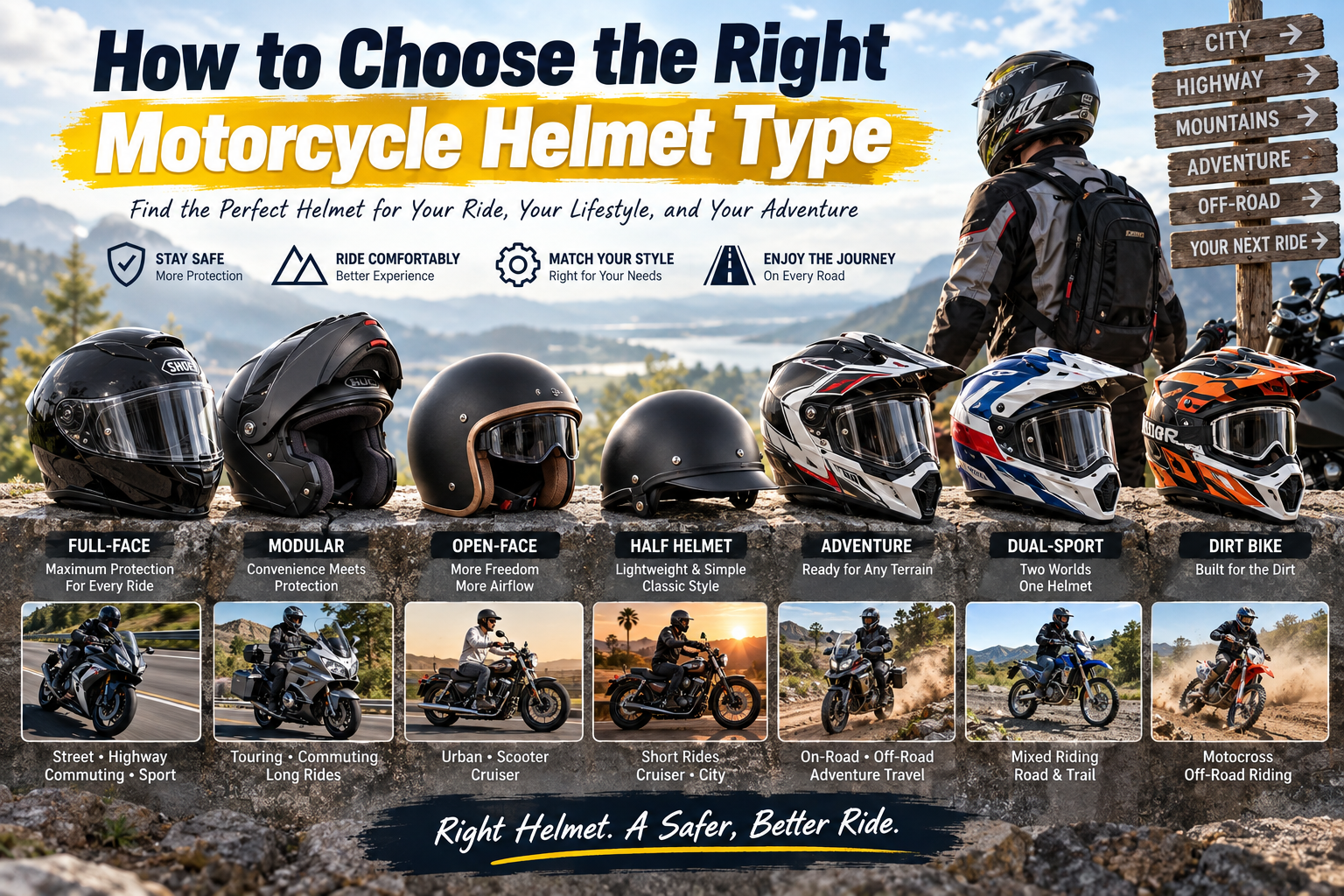
The right motorcycle helmet type depends on how and where you ride. For most everyday street riders, a full-face helmet provides the broadest combination of head and face coverage. Modular helmets add convenience for touring and commuting, adventure helmets suit mixed pavement and off-road riding, dirt-bike helmets are designed for off-road use, and open-face or half helmets prioritize airflow and openness over facial coverage.
Choosing a motorcycle helmet isn’t just about finding a design you like.
The helmet’s construction and shape should match your riding environment, motorcycle, speed, weather, trip length, and desired level of coverage.
A rider commuting through city traffic has different needs from someone touring 500 miles in a day. An ADV rider occasionally leaving the pavement needs something different from a motocross rider spending the entire day on dirt.
In this guide, I’ll explain how to choose the right helmet type, including full-face, modular, open-face, half, adventure, dirt-bike, and dual-sport helmets.
I’ll also show you which types make the most sense for commuting, touring, highway riding, cruisers, sport bikes, hot weather, beginners, and other common riding situations.
Which Motorcycle Helmet Type Should You Choose?
If you want a quick starting point, I would narrow the decision down like this:
| Riding Situation | Helmet Type to Consider | Main Reason |
|---|---|---|
| Everyday street riding | Full-face | Broad head and facial coverage |
| Beginner rider | Full-face | Simple all-around street option |
| Highway riding | Full-face | Wind, debris and weather protection |
| Long-distance touring | Full-face or modular | Protection plus comfort/convenience |
| Daily commuting | Full-face or modular | Useful balance of coverage and practicality |
| Adventure riding | Adventure / dual-sport | Designed for mixed riding conditions |
| Motocross | Dirt-bike helmet | Ventilation, goggles and off-road design |
| Mostly off-road riding | Dirt or ADV | Better suited to low-speed physical riding and dust |
| Maximum openness | Open-face | Open facial area and airflow |
There isn’t one helmet type that is ideal for every rider.
The key is matching the helmet to your actual riding conditions, rather than choosing primarily by appearance.
What Are the Main Types of Motorcycle Helmets?
The major categories you’ll encounter are:
- Full-face helmets
- Modular helmets
- Open-face / 3/4 helmets
- Half helmets
- Adventure / ADV helmets
- Dual-sport helmets
- Dirt-bike / motocross helmets
There are variations within each category, but understanding these basic designs makes helmet shopping considerably easier.
Motorcycle Helmet Types Compared
| Helmet Type | Face Coverage | Airflow | Weather Protection | Typical Use |
|---|---|---|---|---|
| Full-Face | High | Moderate to High | High | Street, highway, sport, commuting |
| Modular | High when closed | Moderate to High | High | Touring, commuting |
| Open-Face | Limited | High | Low to Moderate | Urban, scooter, cruiser |
| Half Helmet | Minimal | Very High | Low | Short urban/cruiser rides |
| Adventure | High | High | Moderate to High | ADV and mixed-surface riding |
| Dirt / Motocross | High shell/chin coverage | Very High | Low | Off-road riding |
Let’s look at each one in more detail.
1. Full-Face Motorcycle Helmets
A full-face helmet surrounds the head and includes a fixed chin bar covering the lower portion of your face.
For many street riders, this is the first category I recommend researching.
Advantages of Full-Face Helmets
- Extensive head and facial coverage
- Fixed chin bar
- Protection from wind
- Protection from insects and road debris
- Better weather isolation than open designs
- Usually suitable for highway speeds
- Many options for sport, touring and commuting
Disadvantages
- Less open feeling than open-face helmets
- Can feel warmer when stationary
- You must raise the visor to expose your face
- Some models can be relatively heavy
Who Should Consider a Full-Face Helmet?
I would strongly consider one for:
- New riders
- Daily commuters
- Sport-bike riders
- Highway riders
- Year-round riders
- Riders frequently traveling at higher speeds
Full-face doesn’t mean every model feels the same.
A lightweight racing helmet, quiet touring helmet, inexpensive commuter helmet and premium carbon-fiber helmet can all belong to the same category while providing very different riding experiences.
2. Modular Motorcycle Helmets
A modular helmet looks similar to a full-face helmet, but its chin bar can pivot upward.
That creates one of the most practical designs for touring and commuting.
Why Riders Choose Modular Helmets
The major advantage is convenience.
At a fuel stop or during a quick conversation, you may be able to raise the chin section rather than removing the entire helmet.
That can be particularly useful for:
- Touring riders
- Motorcycle instructors
- Daily commuters
- Delivery riders
- Riders who frequently stop
Potential Downsides
The hinge and locking mechanism add complexity.
Compared with a comparable full-face helmet, a modular design may also be:
- Heavier
- Bulkier
- More mechanically complex
Not every modular helmet is designed to be ridden with the chin bar raised.
Check the manufacturer’s instructions and helmet certification before riding in the open position.
3. Open-Face Motorcycle Helmets
Open-face helmets—often called three-quarter helmets—typically cover the top, sides and back of the head while leaving the face exposed.
Some include a full visor.
Others use a short shield, goggles or separate eye protection.
Advantages
- Excellent airflow
- Wide field of view
- Easy communication
- Open riding experience
- Popular with scooter and cruiser riders
The Trade-Off
The obvious difference is the lack of a fixed chin bar.
Your lower face is therefore more exposed than it would be in a full-face helmet.
Wind, rain, dust, insects and road debris can also become more noticeable.
I view an open-face helmet as a deliberate trade-off: more openness and airflow in exchange for less facial coverage.
4. Half Helmets
Half helmets provide the least coverage among the common motorcycle helmet designs.
They generally cover the upper portion of the head while leaving much of the face, jaw and lower head exposed.
Why Do Riders Choose Them?
Common reasons include:
- Low weight
- Maximum airflow
- Compact size
- Traditional cruiser styling
- Open riding experience
But those benefits come with considerably less physical coverage.
A rider prioritizing maximum coverage would normally look toward a full-face or another design with a chin bar.
5. Adventure / ADV Helmets
Adventure helmets combine characteristics of street and off-road helmets.
A typical ADV helmet may include:
- Chin bar
- Face shield
- Large eye port
- Extended chin area
- Helmet peak
- Strong ventilation
- Compatibility with goggles on some models
This makes them particularly versatile.
Who Needs an ADV Helmet?
Consider one if your riding regularly includes a combination of:
- Paved roads
- Gravel
- Forest roads
- Trails
- Long-distance travel
The visor makes road sections easier, while the larger opening, ventilation and peak can help when riding away from pavement.
The Peak Matters
The peak can help with sunlight and debris when riding off-road.
At higher road speeds, however, a large peak can interact with airflow and create additional aerodynamic forces or noise.
Some ADV helmets therefore allow the peak to be removed.
6. Dirt Bike / Motocross Helmets
A motocross helmet looks very different from a conventional street helmet.
Typical characteristics include:
- Large eye opening
- Goggle compatibility
- Extended chin bar
- Large peak
- High ventilation
- Low weight
This design makes sense because off-road riding can be physically demanding.
At relatively low speeds, the rider may be working extremely hard, making airflow especially important.
Why Not Simply Use a Motocross Helmet on the Highway?
You can encounter several practical disadvantages.
The large peak can catch airflow, goggles provide different weather isolation than a sealed street visor, and highly ventilated designs may allow considerably more wind and noise.
A helmet optimized for motocross doesn’t automatically make an ideal highway helmet.
7. Dual-Sport Helmets
The terms dual-sport helmet and adventure helmet are often used interchangeably.
Both attempt to bridge the gap between dirt and street helmets.
The important question isn’t what the marketing department calls the helmet.
Ask:
How much of my riding will actually happen on pavement versus dirt?
If 95% of your riding is highway and 5% is gravel, you may value road aerodynamics and noise control more heavily.
If you’re regularly riding technical trails, ventilation, goggle compatibility, weight and off-road ergonomics become more important.
How to Choose a Helmet Based on Riding Style
Rather than choosing by motorcycle alone, think about your actual riding.
Ask yourself:
- Where do I ride?
- How fast do I normally ride?
- How long are my typical rides?
- Do I ride in rain?
- Do I ride in extreme heat?
- Do I regularly use highways?
- Do I ride off-road?
- How important is convenience?
- How important is noise reduction?
- How much coverage do I want?
These questions quickly eliminate unsuitable helmet categories.
What Helmet Type Is Best for Commuting?
For most commuters, I would start by comparing full-face and modular helmets.
A commuter frequently deals with:
- Traffic
- Stop-and-go riding
- Rain
- Wind
- Road debris
- Changing temperatures
- Frequent helmet removal
A full-face helmet provides broad coverage and weather protection.
A modular helmet can be particularly convenient if you’re repeatedly stopping, speaking to people or removing your helmet throughout the day.
Features I Would Prioritize for Commuting
- Comfortable fit
- Good ventilation
- Easy visor operation
- Anti-fog capability
- Removable washable liner
- Useful sun protection
- Reasonable weight
- Good visibility
What Helmet Type Is Best for Highway Riding?
Highway riding increases the importance of aerodynamics, wind management, eye protection and noise.
For that reason, full-face helmets are a logical starting point.
A well-designed full-face street helmet can help isolate you from:
- Strong airflow
- Flying insects
- Dust
- Rain
- Small road debris
Modular touring helmets can also work well, particularly when convenience is important.
For sustained highway use, I pay particular attention to:
- Aerodynamic stability
- Helmet weight
- Ventilation
- Visor sealing
- Noise management
- Neck comfort
What Helmet Type Is Best for Touring?
Touring riders can spend hours wearing the same helmet.
That changes the buying priorities.
Small comfort problems that seem insignificant during a five-minute fitting can become extremely irritating after several hours.
For touring, full-face and modular helmets are common choices.
Touring Features Worth Considering
- Comfortable interior
- Low aerodynamic fatigue
- Effective ventilation
- Anti-fog visor system
- Internal sun visor where desired
- Communication-system compatibility
- Removable liner
- Easy visor replacement
- Availability of replacement parts
Don’t underestimate weight.
Even a relatively small weight difference may become noticeable during long riding days depending on helmet balance and aerodynamics.
What Helmet Type Is Best for Sport Bikes?
Full-face helmets are the conventional choice for sport-bike riding.
Sport-oriented helmets may differ from touring helmets in several ways.
Depending on the model, they can feature:
- Aggressive aerodynamics
- Large eye ports designed around a tucked riding position
- Strong ventilation
- Rear spoilers
- Lightweight shell materials
- Race-oriented visor mechanisms
Your riding position matters.
A helmet developed for an upright touring position may behave differently when you’re tucked behind a sport-bike windscreen.
What Helmet Type Is Best for Cruiser Riders?
Cruiser riders commonly choose among:
- Full-face helmets
- Modular helmets
- Open-face helmets
- Half helmets
Styling plays a large role in this market, but I wouldn’t make style the only consideration.
Think about your speed and distance.
A rider taking short urban trips has very different exposure to wind and weather than a cruiser rider spending hours on an interstate.
For long-distance cruiser touring, a full-face or modular helmet may provide considerably more isolation from wind, weather, insects and road debris.
What Helmet Type Is Best for Hot Weather?
It’s tempting to assume that the smallest helmet is automatically the best summer helmet.
I don’t use that rule.
A well-designed full-face helmet can move a surprising amount of air when riding.
Instead, look at:
- Number and position of intake vents
- Exhaust vent design
- Internal airflow channels
- Liner breathability
- Moisture management
- Helmet color
- Overall fit
Adventure and motocross helmets generally provide substantial ventilation, but remember that they were developed for different riding environments.
What Helmet Type Is Best for Beginners?
For a new street rider, a full-face helmet is an excellent category to investigate first.
It provides:
- Head coverage
- Facial coverage
- Eye protection
- Wind protection
- Weather protection
- Broad compatibility with different street motorcycles
A beginner doesn’t necessarily need the most expensive helmet.
The priority should be finding a properly certified helmet that fits correctly and works for the intended riding conditions.
Check the Helmet’s Safety Certification
Helmet type is only part of the buying decision.
You should also check whether the helmet carries the appropriate recognized certification for your country or riding environment.
Standards you may encounter include:
- DOT FMVSS 218 – commonly encountered in the United States
- ECE 22.06 – widely used internationally
- Snell – independent helmet standards
- FIM homologation – relevant to certain forms of motorcycle racing
Do not assume that an expensive helmet automatically carries every certification.
Likewise, don’t assume that two helmets carrying the same basic certification will have identical comfort, weight, ventilation, features or construction.
Always check the exact model and market version you are purchasing.
Helmet Fit May Matter More Than the Category
You could choose the theoretically perfect helmet type and still make a poor purchase if it doesn’t fit your head correctly.
Motorcycle helmets are available for different head shapes.
Common descriptions include:
- Round
- Intermediate oval
- Long oval
These are general descriptions rather than perfectly standardized measurements.
What Should a New Motorcycle Helmet Feel Like?
A correctly sized helmet should normally feel:
- Snug around your entire head
- Secure when you move your head
- Firm around the cheeks
- Free from concentrated painful pressure points
It should not move loosely around your head.
Try the Helmet for More Than 30 Seconds
When possible, keep the helmet on for approximately 15–30 minutes during fitting.
A helmet can initially feel comfortable but gradually create pressure around the:
- Forehead
- Temples
- Top of the head
- Back of the skull
Persistent localized pressure can indicate that the internal shape doesn’t match your head well.
Features to Consider When Choosing a Helmet
Once you’ve chosen the general helmet category, compare individual models.
1. Ventilation
Look at both intake and exhaust vents.
More vents don’t automatically mean better airflow. Their placement and internal channel design matter.
2. Visor
Consider:
- Optical clarity
- Field of view
- Anti-fog compatibility
- Visor removal system
- Replacement visor availability
- Seal around the eye port
3. Internal Sun Visor
A retractable sun visor can be convenient for commuters and touring riders moving between changing light conditions.
However, not every rider needs one.
4. Weight
Helmet weight becomes particularly important on long rides.
But don’t judge a helmet using the scale alone.
Balance and aerodynamics matter too.
A slightly heavier but well-balanced helmet may feel more comfortable than a lighter helmet that creates aerodynamic strain.
5. Liner
I prefer removable and washable comfort liners for regular-use helmets.
Look for:
- Removable cheek pads
- Removable crown liner
- Breathable materials
- Replacement padding availability
6. Communication System Compatibility
If you use a Bluetooth intercom, check for:
- Speaker recesses
- Microphone clearance
- Wire routing
- External mounting space
Don’t place speakers or hard electronic components where they create pressure against your head.
7. Chin Strap
Depending on the helmet and market, you may encounter:
- Double D-ring systems
- Micrometric ratchet buckles
Make sure you understand how to fasten and adjust the retention system correctly.
8. Replacement Parts
Before purchasing an expensive helmet, I check whether I can obtain:
- Replacement visors
- Pinlock inserts
- Cheek pads
- Crown liners
- Vent components
- Breath guards
A helmet is much easier to maintain when replacement wear components are readily available.
How Much Should You Spend on a Motorcycle Helmet?
Price alone doesn’t determine whether a helmet is appropriate.
You can find certified helmets across a wide range of prices.
As price increases, you’re often paying for some combination of:
- More sophisticated shell construction
- Lower weight
- More shell sizes
- Improved ventilation
- Better interior materials
- More refined aerodynamics
- Visor systems
- Replaceable components
- Premium graphics and finishes
My buying order would be:
- Appropriate certification
- Correct size
- Correct head shape
- Suitable helmet type
- Comfort
- Features
- Finish and styling
I would rather wear a less expensive certified helmet that fits correctly than a premium helmet that doesn’t match my head.
Full-Face vs Modular Helmet
This is one of the most common comparisons.
| Feature | Full-Face | Modular |
|---|---|---|
| Fixed chin bar | Yes | No – hinged |
| Convenience at stops | Moderate | High |
| Typical weight | Often lower | Often higher |
| Mechanical complexity | Lower | Higher |
| Touring suitability | Excellent | Excellent |
| Commuting suitability | Excellent | Excellent |
Choose based on your priorities.
If I wanted simplicity and a fixed chin bar, I would focus on full-face helmets.
If I frequently stopped and valued easy face access, I would compare modular options.
Full-Face vs Open-Face Helmet
The primary difference is straightforward: facial coverage.
A full-face helmet incorporates a chin bar.
An open-face helmet does not.
Open-face helmets offer a more open experience and excellent airflow, but the rider’s face remains more exposed to weather, insects, road debris and impact.
For regular high-speed riding, this distinction becomes particularly important.
Adventure Helmet vs Full-Face Street Helmet
Choose based on where you’re actually going to ride.
Street Full-Face Makes More Sense When:
- You primarily ride pavement
- You frequently use highways
- Road aerodynamics matter
- Weather isolation is important
Adventure Helmet Makes More Sense When:
- You regularly ride dirt and gravel
- You want a peak
- You need substantial ventilation
- You want goggle compatibility
- Your trips combine road and trail riding
Don’t buy an ADV helmet solely because you own an adventure-style motorcycle.
Choose according to where the motorcycle actually goes.
10 Motorcycle Helmet Selection Mistakes to Avoid
- Choosing entirely by appearance. Style matters, but riding conditions and fit should come first.
- Buying the wrong size. A loose helmet isn’t corrected by choosing the right category.
- Ignoring head shape. Two helmets labeled the same size can fit very differently.
- Buying too large for comfort. Comfort padding can settle after use.
- Ignoring certification. Check the exact helmet and market version.
- Buying a dirt helmet for mostly highway riding without considering the trade-offs.
- Assuming modular helmets can always be ridden open. Check the manufacturer’s instructions.
- Ignoring replacement parts. Visors and liners eventually wear.
- Choosing by motorcycle style rather than actual riding. Your use case matters more than matching aesthetics.
- Assuming expensive automatically means better fitting. Fit is individual.
Motorcycle Helmet Selection Checklist
- ✓ Identify where you ride most often.
- ✓ Decide how much facial coverage you want.
- ✓ Check applicable safety certification.
- ✓ Measure your head circumference.
- ✓ Determine your approximate head shape.
- ✓ Try the helmet on whenever possible.
- ✓ Check for painful pressure points.
- ✓ Make sure the helmet isn’t loose.
- ✓ Check field of view.
- ✓ Evaluate ventilation.
- ✓ Check visor operation.
- ✓ Consider anti-fog capability.
- ✓ Check helmet weight and balance.
- ✓ Consider intercom compatibility.
- ✓ Check whether the liner is removable.
- ✓ Check replacement visor availability.
- ✓ Check replacement liner and cheek-pad availability.
- ✓ Consider your typical riding duration.
- ✓ Consider highway versus off-road use.
- ✓ Read the manufacturer’s instructions before riding.
My Simple Helmet-Type Decision Process
If I were choosing a new helmet, I would use this sequence:
Step 1: Determine Where I Ride
Street only?
Mixed road and dirt?
Dedicated motocross?
That immediately narrows the categories.
Step 2: Decide How Much Coverage I Want
If broad facial coverage is a priority, I would focus on designs with a chin bar.
Step 3: Determine My Head Size and Shape
This eliminates helmets that simply don’t fit correctly.
Step 4: Verify Certification
I check the exact helmet model and certification markings appropriate to my location.
Step 5: Compare Comfort
I wear promising helmets long enough to identify pressure points.
Step 6: Compare Features
Only after fit do I start prioritizing:
- Sun visor
- Pinlock
- Bluetooth compatibility
- Graphics
- Weight
- Premium liner materials
That order prevents attractive features from distracting me from the fundamentals.
Which Motorcycle Helmet Type Gives the Most Coverage?
Among conventional street helmet designs, a full-face helmet provides extensive coverage because the shell surrounds the head and incorporates a fixed chin bar.
Modular helmets also provide substantial coverage when properly closed and used according to their design and certification.
Open-face and half helmets leave progressively more of the face exposed.
However, helmet type isn’t the only consideration.
A helmet must also fit correctly and meet the appropriate safety requirements.
Does Your Motorcycle Determine Your Helmet Type?
Not necessarily.
There are traditional combinations:
- Sport bike → full-face
- Touring bike → full-face or modular
- Adventure bike → ADV helmet
- Motocross bike → dirt helmet
- Cruiser → full-face, modular, open-face or half helmet
But these aren’t rules.
Your actual riding environment is more useful than the motorcycle’s styling.
Someone commuting on an adventure motorcycle almost entirely on highways may prefer a street-oriented full-face helmet.
Likewise, someone using a dual-sport motorcycle primarily on trails may prefer a much more dirt-oriented design.
Frequently Asked Questions About Motorcycle Helmet Types
What type of motorcycle helmet should I buy?
Start with your riding environment. Full-face helmets are versatile for general street riding, modular helmets add convenience for touring and commuting, adventure helmets suit mixed surfaces, and motocross helmets are designed primarily for off-road riding.
What is the best helmet type for a beginner?
A properly fitting, appropriately certified full-face helmet is a sensible category for new street riders to investigate because it provides extensive head, face, eye and weather coverage.
Is a full-face helmet better than an open-face helmet?
They prioritize different things. Full-face helmets provide additional facial and chin coverage, while open-face helmets provide a more open riding experience and greater direct airflow.
What is the difference between a full-face and modular helmet?
A full-face helmet uses a fixed chin bar. A modular helmet uses a hinged chin section that can be raised on compatible models. This makes modular helmets convenient but adds weight and mechanical complexity.
Are modular helmets good for long-distance riding?
They are popular among touring riders because the lifting chin bar can make stops and communication more convenient. Fit, weight, aerodynamics, ventilation and certification should still be evaluated for the specific model.
Are adventure helmets good for highway riding?
Many adventure helmets are designed for both pavement and off-road use. However, peaks and highly ventilated designs can behave differently in highway airflow compared with street-focused helmets.
Can I use a dirt-bike helmet on the street?
This depends on the helmet’s road-legal certification and local requirements. Even where permitted, a dirt-oriented helmet may be less convenient for sustained road riding because of wind, noise, peak aerodynamics and the use of goggles rather than a conventional sealed visor.
Should I buy a half helmet for hot weather?
A half helmet provides substantial direct airflow but also less coverage. Well-ventilated full-face and adventure helmets can provide considerable airflow while retaining more head and facial coverage.
How tight should a motorcycle helmet be?
A new helmet should fit snugly around your head without creating concentrated painful pressure points. It shouldn’t rotate or slide freely when you move the helmet.
Does motorcycle helmet brand matter?
Brand alone shouldn’t determine your decision. Consider certification, fit, head-shape compatibility, construction, comfort, replacement parts, features and suitability for your riding conditions.
Should I buy a helmet online?
You can, but helmet sizing varies between manufacturers and even between models. Ideally, try the model first or purchase from a seller with a suitable return or exchange policy.
Is a more expensive motorcycle helmet safer?
Price alone isn’t a direct measurement of protection. More expensive helmets may offer premium materials, lower weight, more sophisticated ventilation, refined aerodynamics, improved liners or additional features. Check certification and fit rather than using price alone.
Final Thoughts
Learning how to choose the right helmet type becomes much easier when you stop thinking about helmets primarily as fashion accessories and start thinking about where and how you actually ride.
For general street and highway riding, a full-face helmet is a strong starting point.
For touring and frequent stops, compare full-face and modular designs.
For genuine mixed-surface riding, look closely at adventure helmets.
For dedicated off-road riding, a motocross helmet makes more sense.
Open-face and half helmets provide greater openness but leave more of the rider exposed.
After selecting the category, focus on the details that ultimately determine whether you’ll actually enjoy wearing the helmet:
certification, correct size, head shape, comfort, ventilation, visibility, weight, and suitability for your riding conditions.
The best helmet isn’t simply the most expensive or the most attractive.
It’s the one that appropriately matches your riding and fits your head correctly every time you get on the motorcycle.
Authoritative Sources & Further Reading
- Check current helmet requirements and safety information from your country’s transportation authority.
- Review the helmet manufacturer’s official owner’s manual before use.
- Verify the certification markings on the exact helmet model and market version you purchase.
Daniel Carter | Motorcycle Gear Specialist & Helmet Expert
Daniel Carter is a rider and motorcycle equipment analyst specializing in helmet safety standards, protective apparel, and riding technology. He provides in-depth technical reviews and gear advice to help riders stay safe, comfortable, and fully equipped on every journey.
Editor & Author @ BestMotorcycleHelmet.com
1 thought on “How to Choose the Right Motorcycle Helmet Type”
Comments are closed.