
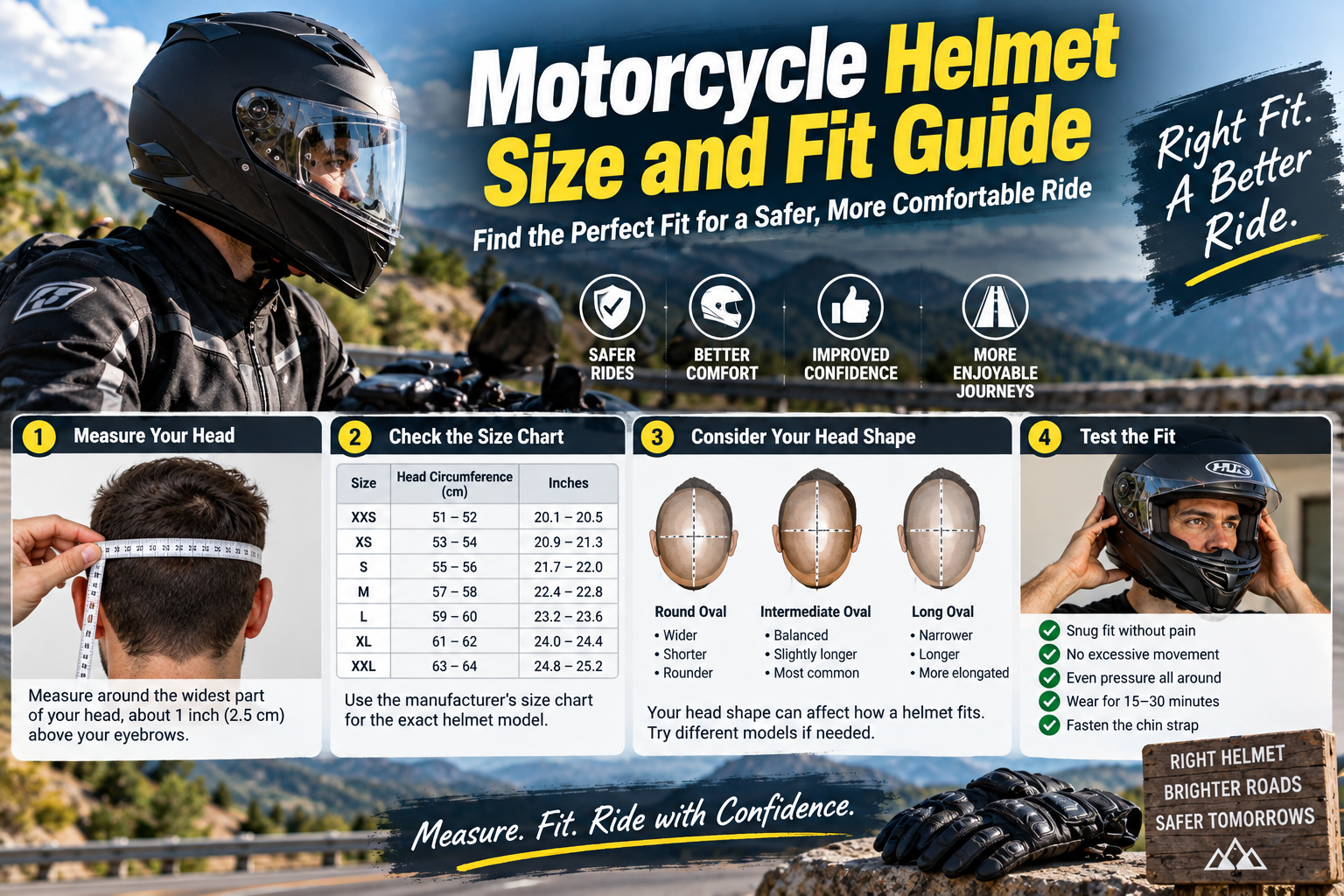
Motorcycle Helmet Size and Fit Guide: How to Find the Perfect Fit
A motorcycle helmet should fit snugly and evenly around your entire head without creating painful pressure points. To find your size, measure the circumference of your head approximately 1 inch (2.5 cm) above your eyebrows, compare that measurement with the specific manufacturer’s size chart, identify your head shape, and wear the helmet for at least 15–30 minutes before deciding whether the fit is correct.
Choosing the right motorcycle helmet size is about much more than knowing whether you normally wear a medium or large.
Two helmets labeled “Medium” can fit completely differently.
Helmet sizing varies between manufacturers and even between different models from the same brand. Your head circumference, head shape, cheek fit, crown fit, and the helmet’s internal shape all affect whether a helmet fits correctly.
A helmet that is too loose can move excessively around your head.
A helmet that is too tight may create painful pressure points and headaches.
In this motorcycle helmet size and fit guide, I’ll show you how to measure your head, understand helmet sizing, identify your head shape, perform several fit tests, recognize a helmet that is too large or too small, and choose the right size when buying online.
How Should a Motorcycle Helmet Fit?
A properly fitting motorcycle helmet should feel snug everywhere without creating painful pressure points.
When the helmet is new, it may feel tighter than you expect.
That’s normal.
The comfort liner and cheek pads can compress somewhat with regular use.
However, “snug” does not mean painful.
A correctly fitted helmet should:
- Contact your head evenly
- Feel secure around the crown
- Fit firmly around your cheeks
- Move your scalp when you move the helmet
- Resist excessive rotation
- Stay securely positioned when the chin strap is fastened
- Not create concentrated painful pressure points
How to Measure Your Head for a Motorcycle Helmet
Before looking at helmet sizes, measure your head.
You’ll need:
- A flexible measuring tape
- A mirror, if measuring yourself
- Someone to help, if possible
Step 1: Position the Measuring Tape
Wrap a soft measuring tape around the widest part of your head.
As a general starting point, position it approximately:
- 1 inch / 2.5 cm above your eyebrows
- Above your ears
- Around the widest portion at the back of your head
Keep the tape approximately level.
Step 2: Keep the Tape Snug
The measuring tape should sit against your head without squeezing tightly.
Don’t measure over:
- A hat
- Thick headwear
- Bulky hairstyles
You want the measurement to represent the circumference of your head.
Step 3: Record the Measurement
Record the measurement in both centimeters and inches if convenient.
For example:
58 cm / approximately 22.8 inches
Helmet manufacturers frequently provide sizing charts in centimeters.
Step 4: Measure Again
I recommend measuring at least twice.
If the results differ, check your tape position and repeat the measurement.
A difference of even 1 cm can matter when you’re near the boundary between two helmet sizes.
Motorcycle Helmet Size Chart
The following chart is a general reference only.
| Helmet Size | Approx. Head Circumference | Approx. Inches |
|---|---|---|
| XXS | 51–52 cm | 20.1–20.5 in |
| XS | 53–54 cm | 20.9–21.3 in |
| S | 55–56 cm | 21.7–22.0 in |
| M | 57–58 cm | 22.4–22.8 in |
| L | 59–60 cm | 23.2–23.6 in |
| XL | 61–62 cm | 24.0–24.4 in |
| XXL | 63–64 cm | 24.8–25.2 in |
Do not use this generic chart as a substitute for the manufacturer’s size chart.
Sizing can vary significantly between brands and models.
If your head measures 58 cm, for example, that might place you in Medium for one helmet but potentially another size or fit range for a different model.
Always check the chart for the exact helmet you’re considering.
Understanding Motorcycle Helmet Head Shapes
Head circumference tells you approximately what helmet size to try.
Head shape determines whether that size actually fits correctly.
This is one of the most overlooked parts of motorcycle helmet fitting.
Three general head-shape descriptions are commonly used:
- Round oval
- Intermediate oval
- Long oval
Round Oval
A round-oval head has a front-to-back measurement that is relatively similar to its side-to-side measurement.
Viewed from above, the head appears comparatively round.
A helmet designed for a much longer head shape may create an incorrect fit on someone with a rounder head.
Intermediate Oval
Intermediate oval generally describes a head that is somewhat longer from front to back than from side to side.
Many street helmets are marketed around this general shape, although actual internal geometry varies between models.
Long Oval
A long-oval head is noticeably longer from front to back than from side to side.
Someone with a long-oval head wearing a rounder helmet may experience excessive pressure at the forehead and back of the head.
| Head Shape | Front-to-Back | Side-to-Side | Typical Appearance From Above |
|---|---|---|---|
| Round Oval | Relatively short | Relatively wide | Rounder |
| Intermediate Oval | Moderately longer | Moderately narrower | Oval |
| Long Oval | Noticeably longer | Narrower | Elongated oval |
How Do You Determine Your Head Shape?
Head shape can be harder to determine than circumference.
One simple method is to have someone look down at your head from above.
Flatten your hair as much as reasonably possible.
A photo taken directly above your head can also help.
You’re looking at the overall relationship between:
front-to-back length vs. side-to-side width.
Don’t overthink the terminology.
The practical test is ultimately how a particular helmet contacts your head.
If one area hurts while another area feels loose, the problem may be shape rather than size.
What Does a Properly Fitting Motorcycle Helmet Feel Like?
When you first put on a properly sized new helmet, you should feel firm contact around most of your head.
You should not feel large empty spaces.
At the same time, you shouldn’t experience sharp or painful pressure.
Good Pressure
Normal new-helmet pressure can feel like:
- Firm contact around the crown
- Cheeks being gently compressed
- Even pressure around your head
- A secure “wrapped” feeling
Bad Pressure
Warning signs include:
- Sharp forehead pain
- Strong pressure on one temple
- Burning pressure points
- Numbness
- Headache developing quickly
- Pain concentrated at the back of the skull
Those symptoms can indicate either an incorrect size or an incompatible helmet shape.
How to Perform a Motorcycle Helmet Fit Test
Once the helmet is on, don’t judge it solely by first impressions.
Perform several simple tests.
Test 1: Check Overall Contact
Feel around the helmet.
There should be reasonably even contact around your head.
Large gaps may indicate an incorrect fit.
Test 2: Move the Helmet Side to Side
Hold the helmet and gently rotate it left and right.
Your skin and scalp should move with the helmet.
If the helmet rotates substantially while your head remains relatively stationary inside it, the fit may be too loose.
Test 3: Move It Front to Back
Try gently moving the helmet forward and backward.
Again, your skin should move with it.
Excessive independent movement is a warning sign.
Test 4: Check the Cheeks
Full-face helmets normally compress the cheeks when new.
Try moving the helmet laterally.
Your cheeks should move with the cheek pads.
Test 5: Fasten the Chin Strap
Always evaluate final fit with the retention system properly fastened.
Test 6: Try the Roll-Off Test
With the strap securely fastened, carefully attempt to roll the helmet forward off your head from the rear.
It should resist being pulled off.
If the helmet can easily roll off your head while correctly fastened, something is wrong with the fit, adjustment, or helmet choice.
Test 7: Wear It for 15–30 Minutes
This is one of my most important tests.
A helmet that feels fine for two minutes may become painful after 15 minutes.
Wear it indoors for approximately 15–30 minutes before deciding.
Pay attention to:
- Forehead pressure
- Temple pressure
- Pressure behind the ears
- Top-of-head pressure
- Cheek discomfort
How Do You Know if a Motorcycle Helmet Is Too Big?
A helmet may be too large if:
- It slides easily around your head
- It rotates independently of your scalp
- You can easily create large gaps around the liner
- It shifts when you quickly turn your head
- It moves noticeably during normal riding
- It can be rolled excessively forward or backward
- Your cheeks barely contact the cheek pads
A helmet shouldn’t feel like a loose hat.
How Do You Know if a Motorcycle Helmet Is Too Small?
A helmet may be too small—or the wrong shape—if you experience:
- Significant pain
- Severe forehead pressure
- Strong temple pressure
- Numbness
- Rapidly developing headache
- Difficulty wearing it for more than a few minutes
However, don’t confuse normal snugness with being too small.
A new helmet can feel surprisingly tight, particularly around the cheek pads.
Size Problem vs. Shape Problem
This distinction is extremely important.
Suppose the helmet feels:
- Very tight at the forehead
- But loose at the sides
Going up one size may relieve the forehead pressure—but make the rest of the helmet too loose.
The real problem may be that you need a helmet with a different internal shape.
How Should Motorcycle Helmet Cheek Pads Fit?
Cheek pads should make firm contact with your cheeks.
A new full-face helmet may push your cheeks inward enough that biting down causes you to lightly catch the inside of your cheeks.
That’s not necessarily a problem.
Cheek pads commonly soften and compress somewhat with use.
However, they shouldn’t cause:
- Significant pain
- Numbness
- Severe jaw discomfort
- Difficulty closing your mouth normally
Some premium helmets offer different cheek-pad thicknesses.
This can help fine-tune the fit.
But remember:
Cheek pads cannot correct an incorrectly sized crown.
If the main helmet shell and crown liner are too loose, thicker cheek pads alone don’t necessarily solve the underlying fit problem.
Do Motorcycle Helmets Break In?
Yes—but only certain parts.
The comfort liner and cheek pads can compress and conform somewhat as you wear the helmet.
The structural impact liner should not be expected to “break in” like a pair of shoes.
What Usually Changes?
Over time:
- Cheek pads may soften
- Comfort padding may compress
- The helmet may feel slightly less tight
What Should Not Be Modified?
Do not intentionally:
- Compress the EPS impact liner
- Sand the EPS
- Cut the EPS
- Carve pressure-point areas
- Remove structural material
If a helmet doesn’t match your head shape, choose a different model rather than modifying its protective structure.
How Long Does It Take to Break In a Motorcycle Helmet?
There isn’t one exact break-in period.
It depends on:
- Padding material
- How often you ride
- Cheek-pad thickness
- Helmet construction
- Your head and face shape
You may notice the comfort liner settling during the first several rides.
The important buying principle is:
Don’t buy a helmet that is already loose when new and expect the fit to improve.
Padding generally becomes less snug with use.
What Should You Do if You’re Between Helmet Sizes?
Suppose your measurement places you exactly between Medium and Large.
Don’t automatically choose the larger size.
Instead:
- Check the exact manufacturer’s chart.
- Try both sizes if possible.
- Wear each for 15–30 minutes.
- Check crown movement.
- Check pressure points.
- Perform the rotation test.
- Consider the helmet’s internal shape.
If the smaller helmet provides firm, even contact without painful pressure, it may remain more secure after the comfort padding settles.
But sizing should never be forced purely to follow a rule.
The correct size is the one that provides the appropriate secure fit for your head according to the manufacturer’s fitting guidance.
Do Motorcycle Helmet Sizes Differ Between Brands?
Yes.
This is why I don’t recommend thinking:
“I’m always a Medium.”
You might wear:
- Medium in one brand
- Large in another
- Different sizes in two models from the same manufacturer
Differences can come from:
- Size charts
- Internal head shape
- Comfort liner thickness
- Cheek-pad thickness
- Shell sizing
- EPS configuration
Always start again with the specific manufacturer’s chart.
What Are Motorcycle Helmet Shell Sizes?
Helmet manufacturers don’t necessarily manufacture a completely different outer shell for every labeled size.
A helmet range may use several outer shell sizes and adjust internal components to create different fit sizes.
For example, multiple neighboring sizes may sometimes share an outer shell.
Using more shell sizes can help manufacturers optimize:
- Exterior dimensions
- Weight
- Fit
- Proportions
If exterior size matters to you, check how many shell sizes the specific helmet uses.
How to Buy a Motorcycle Helmet Online and Get the Right Size
Buying online gives you access to far more models, but fit becomes more challenging.
Here’s the process I use.
1. Measure Your Head
Don’t guess based on your previous helmet.
Measure again.
2. Identify Your Head Shape
Determine whether you’re approximately:
- Round oval
- Intermediate oval
- Long oval
3. Check the Exact Manufacturer Chart
Don’t use a generic motorcycle helmet chart when ordering.
4. Research the Specific Model’s Internal Shape
Two models from the same company may fit differently.
5. Check the Return Policy
This is extremely important.
You may need to exchange the helmet for:
- Another size
- Another model
- Another internal shape
6. Keep Everything Clean
When test-fitting a helmet you may return:
- Keep tags attached where required
- Keep packaging
- Don’t ride in it
- Don’t install accessories
- Follow the retailer’s return conditions
7. Wear It Indoors
Use the 15–30 minute pressure-point test before committing to the helmet.
How Should a Motorcycle Helmet Fit With Glasses?
If you regularly wear prescription glasses or sunglasses while riding, test the helmet with them.
Check whether:
- The arms slide into position easily
- The helmet pushes the glasses painfully into your temples
- The glasses remain correctly positioned
- The cheek pads distort the frame
- The visor closes without interference
Some helmets include channels designed to accommodate glasses.
However, don’t buy an oversized helmet just to create room for your eyewear.
Look for a correctly sized helmet that accommodates your glasses properly.
How Should a Helmet Fit Around Your Forehead?
Your forehead should have firm, relatively even contact with the liner.
A small amount of temporary pressure from a snug new helmet can be normal.
Persistent concentrated pain is different.
If you develop a strong red pressure mark or pain in the center of your forehead while the sides feel relatively loose, the helmet’s internal shape may be too round for your head.
Trying a longer internal shape may be more effective than simply buying a larger helmet.
Should Your Ears Hurt in a Motorcycle Helmet?
Your ears may fold slightly while putting some helmets on.
You can usually adjust them once the helmet is fully seated.
But your ears shouldn’t remain painfully folded or compressed during riding.
If they do, check:
- Helmet position
- Liner arrangement
- Speaker placement
- Helmet size
- Helmet shape
Be particularly careful with Bluetooth speakers.
A poorly positioned speaker can create a painful pressure point that has nothing to do with helmet sizing.
Does Helmet Type Affect Fit?
Yes.
Different helmet categories can feel different even when the labeled size is identical.
Full-Face Helmets
Expect substantial cheek contact and a secure crown fit.
Modular Helmets
Fit principles are similar to full-face helmets, although the internal design and chin-bar mechanism can affect the overall feel.
Adventure Helmets
The large eye port and off-road-inspired design may create a different facial feel, but the crown still needs to fit securely.
Open-Face Helmets
There are no full-face cheek pads and chin bar surrounding the face, so evaluating crown security and retention becomes particularly important.
Motocross Helmets
These use large eye openings for goggles and off-road-oriented interiors, but they should still fit securely around the head.
For a complete breakdown, see our guide to choosing the right motorcycle helmet type.
Motorcycle Helmet Sizing for Children
Children need properly sized helmets just like adults.
Do not intentionally buy an oversized helmet for a child to “grow into.”
A helmet needs to fit correctly during current use.
Measure the child’s head and use the manufacturer’s youth sizing chart for the exact helmet.
Check:
- Crown fit
- Side-to-side movement
- Front-to-back movement
- Chin-strap adjustment
- Pressure points
- Helmet weight
Recheck fit periodically because children’s head dimensions can change as they grow.
Can You Make a Loose Helmet Fit With Thicker Cheek Pads?
Sometimes cheek-pad changes can fine-tune facial fit.
They should not be used to disguise an incorrectly fitting crown.
If the helmet moves excessively around the top of your head, changing only the cheek pads may not solve the actual sizing problem.
Some manufacturers offer:
- Different cheek-pad thicknesses
- Different crown-liner thicknesses
Only use components specifically intended and approved for the helmet model.
Can You Wear a Balaclava Under a Motorcycle Helmet?
Yes, provided the helmet still fits correctly.
A thin motorcycle balaclava can help with:
- Sweat management
- Cold weather
- Keeping the liner cleaner
But thick headwear can change helmet fit.
If you regularly use a balaclava, test your helmet with the type you actually intend to wear.
Should a Motorcycle Helmet Move When You Shake Your Head?
Very little independent movement should occur.
Fasten the helmet properly and move your head:
- Left and right
- Up and down
- Quickly side to side
The helmet should move with your head rather than lagging behind or shifting independently.
If it noticeably slides around, investigate the fit.
10 Motorcycle Helmet Sizing Mistakes to Avoid
- Buying your usual size without measuring. Helmet sizing varies.
- Ignoring head shape. Circumference alone doesn’t determine fit.
- Buying one size larger for comfort. New comfort padding normally settles with use.
- Testing the helmet for only 30 seconds. Pressure points can take time to appear.
- Assuming every model from one brand fits identically. Internal shapes can vary.
- Confusing cheek pressure with an undersized helmet. New cheek pads are often firm.
- Trying to fix a crown that’s too loose with cheek pads. They address different areas.
- Ignoring forehead pain. Persistent localized pressure can indicate a shape mismatch.
- Modifying the EPS liner. Never cut, sand or compress protective foam to create more space.
- Buying an oversized children’s helmet to allow for growth. A helmet should fit properly during current use.
Motorcycle Helmet Fit Checklist
- ✓ Measure your head circumference.
- ✓ Measure at least twice.
- ✓ Use the exact manufacturer’s sizing chart.
- ✓ Identify your approximate head shape.
- ✓ Put the helmet fully onto your head.
- ✓ Fasten the chin strap correctly.
- ✓ Check for even crown contact.
- ✓ Check cheek-pad pressure.
- ✓ Rotate the helmet side to side.
- ✓ Move it front to back.
- ✓ Confirm your scalp moves with the helmet.
- ✓ Perform a careful roll-off test.
- ✓ Wear the helmet for 15–30 minutes.
- ✓ Check for forehead pain.
- ✓ Check for temple pressure.
- ✓ Check your ears.
- ✓ Test your glasses if you wear them.
- ✓ Check visibility.
- ✓ Don’t modify the EPS liner.
- ✓ Remember that comfort padding can settle with use.
My Motorcycle Helmet Fitting Process
When I’m evaluating a helmet, I use this order:
Step 1: Measure
I measure my head circumference rather than relying on the size of my previous helmet.
Step 2: Check the Manufacturer’s Chart
That gives me my starting size.
Step 3: Consider Head Shape
I check whether the model’s internal shape appears compatible with my head.
Step 4: Put the Helmet On Correctly
I pull the straps outward slightly and roll the helmet onto my head.
Step 5: Check Crown Security
I look for even contact without large gaps.
Step 6: Check Movement
I rotate the helmet and confirm that my scalp moves with it.
Step 7: Check Cheeks
Firm pressure is expected with many new full-face helmets.
Step 8: Wait
I keep the helmet on for 15–30 minutes.
This is where shape problems often reveal themselves.
Step 9: Check Retention
I fasten the strap and carefully test whether the helmet remains securely positioned.
Step 10: Compare Another Size if Necessary
If I’m uncertain, I don’t guess.
I compare another size or another helmet shape.
Motorcycle Helmet Size vs. Fit: What’s More Important?
The size printed on the helmet is only a starting point.
Fit is the final test.
Think of it this way:
| Factor | What It Tells You |
|---|---|
| Head circumference | Approximate starting size |
| Manufacturer size chart | Recommended size range |
| Head shape | Which internal geometry may suit you |
| Pressure-point test | Whether the internal shape works |
| Movement test | Whether the helmet is too loose |
| Long fitting session | Whether the helmet remains comfortable |
That’s why I wouldn’t buy a motorcycle helmet based solely on a measurement chart.
Frequently Asked Questions About Motorcycle Helmet Size and Fit
How do I know my motorcycle helmet size?
Measure the circumference of your head around its widest area, typically approximately 1 inch or 2.5 cm above the eyebrows and around the widest point at the back. Compare that measurement with the size chart for the exact helmet manufacturer and model you’re considering.
How tight should a motorcycle helmet be?
A motorcycle helmet should feel snug and secure around your entire head without creating concentrated painful pressure points. Your skin and scalp should move when you rotate the helmet.
Should a new motorcycle helmet feel tight?
Yes. A new helmet commonly feels quite snug because its comfort padding has not yet settled. Firm, even pressure can be normal; significant pain, numbness or concentrated pressure is not.
How do I know if my motorcycle helmet is too big?
A helmet may be too big if it rotates easily around your head, shifts independently when you move, has obvious internal gaps, or can be moved excessively forward and backward.
How do I know if my motorcycle helmet is too small?
A helmet may be too small or the wrong shape if it causes significant pain, numbness, severe pressure or headaches. Localized pressure can also indicate an internal-shape mismatch rather than simply an undersized helmet.
Should my cheeks be squeezed in a motorcycle helmet?
A new full-face helmet should normally make firm contact with your cheeks. The cheek pads may feel quite snug initially and can soften somewhat with regular use.
Do motorcycle helmets loosen over time?
Comfort liners and cheek pads can compress and soften with use, making the helmet feel slightly less snug. The protective EPS impact liner should not be intentionally compressed or modified.
What if I’m between motorcycle helmet sizes?
Try both sizes when possible. Evaluate crown contact, pressure points, movement and head shape rather than automatically choosing the larger size.
Are all motorcycle helmet sizes the same?
No. Size ranges and internal shapes vary between manufacturers and models. Always use the sizing information for the exact helmet you’re buying.
How long should I try on a motorcycle helmet?
Wear a prospective helmet indoors for approximately 15–30 minutes. This gives concentrated pressure points time to become noticeable.
Should a motorcycle helmet move when I shake my head?
It should move with your head rather than sliding independently around it. Excessive movement can indicate an overly loose fit.
Can I make my motorcycle helmet tighter?
Some manufacturers offer different approved cheek-pad or comfort-liner thicknesses for specific models. These can fine-tune fit, but they shouldn’t be used to compensate for a fundamentally incorrect helmet size.
Can I make a tight motorcycle helmet bigger?
Do not cut, sand or compress the EPS impact liner. If the helmet remains painfully tight or has the wrong internal shape, try another size or model.
Is head shape important when buying a motorcycle helmet?
Yes. Two people with the same head circumference can require different helmets because one may have a rounder head while another has a longer, narrower head.
Final Thoughts
Finding the correct motorcycle helmet size and fit requires more than measuring your head and ordering whatever letter appears beside that number.
Start with your head circumference.
Then check the manufacturer’s specific sizing chart.
Next, consider your head shape.
Finally, actually evaluate the fit.
A good motorcycle helmet should feel snug, stable and evenly supported without creating concentrated painful pressure points.
When you move the helmet, your scalp should move with it. When the chin strap is properly fastened, the helmet should resist excessive movement or roll-off.
And don’t forget that a new helmet’s comfort padding can settle.
Don’t intentionally choose a loose helmet because it feels more comfortable during the first few minutes.
If you’re stuck between two helmets, prioritize proper crown fit and head-shape compatibility over brand name, graphics or extra features.
The helmet that correctly fits your individual head is ultimately the helmet you’ll be more comfortable wearing every time you ride.
Authoritative Sources & Further Reading
For final sizing and fitting, always consult the documentation supplied by the manufacturer of the exact helmet you’re considering. Manufacturer-specific size ranges, internal shapes, cheek-pad options and fitting instructions can differ between models.
- Check the helmet manufacturer’s official sizing chart.
- Read the owner’s manual supplied with the helmet.
- Follow manufacturer instructions for adjusting or replacing comfort liners and cheek pads.
- Never modify the structural shell or EPS impact liner to change fit.

Daniel Carter | Motorcycle Gear Specialist & Helmet Expert
Daniel Carter is a rider and motorcycle equipment analyst specializing in helmet safety standards, protective apparel, and riding technology. He provides in-depth technical reviews and gear advice to help riders stay safe, comfortable, and fully equipped on every journey.
Editor & Author @ BestMotorcycleHelmet.com