
How to Clean a Motorcycle Helmet: Complete Step-by-Step Guide
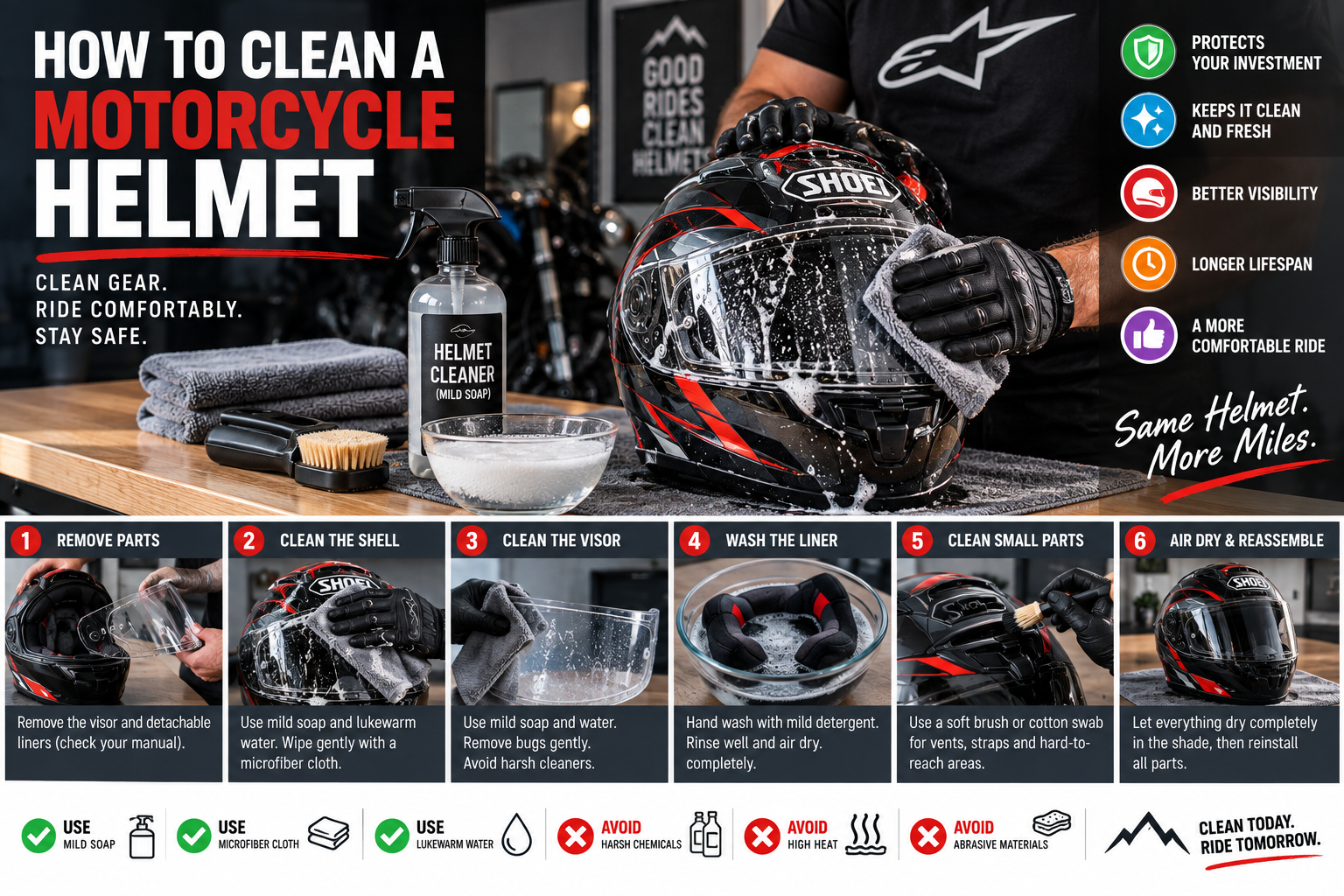
The safest way to clean a motorcycle helmet is to use mild neutral soap, lukewarm water, and soft microfiber cloths while following the helmet manufacturer’s instructions. Remove washable comfort liners when possible, clean the visor separately, avoid petroleum solvents and harsh household cleaners, and let all components air-dry completely away from direct heat.
A motorcycle helmet collects far more dirt than most riders realize. Sweat, skin oils, sunscreen, dust, insects, rain residue, road grime, and hair products can all build up over time.
Cleaning it properly improves comfort, visibility, smell, and overall condition. Cleaning it incorrectly, however, can damage the visor, plastics, coatings, adhesives, or impact-absorbing liner.
In this guide, I’ll show you how to clean a motorcycle helmet safely, including the shell, visor, removable liner, fixed interior, vents, cheek pads, and chin strap.
How Do You Clean a Motorcycle Helmet?
For most helmets, the basic process is:
- Remove the visor and removable comfort padding if the manual permits it.
- Soften dried bugs and dirt with a damp microfiber cloth.
- Clean the shell with mild neutral soap and water.
- Wash removable padding gently.
- Wipe fixed interior components rather than soaking them.
- Clean vents and small areas with a soft brush or cotton swab.
- Rinse soap residue away.
- Allow everything to air-dry completely in the shade.
- Reassemble the helmet carefully.
- Inspect all components before riding.
The most important rule is simple: never assume a strong cleaner is better.
Helmet materials can be sensitive to solvents, petroleum-based chemicals, aggressive detergents, and excessive heat.
What You Need to Clean a Motorcycle Helmet
You don’t need an expensive collection of detailing products.
My basic helmet-cleaning kit includes:
- 2–4 clean microfiber cloths
- Mild neutral soap or detergent
- Lukewarm water
- Small bowl or sink
- Soft toothbrush
- Cotton swabs
- Clean towel
- Helmet manufacturer’s manual
Depending on the helmet, you may also use a manufacturer-approved helmet cleaner.
What I Do Not Use
I avoid products such as:
- Gasoline
- Benzine
- Paint thinner
- Brake cleaner
- Degreaser
- Acetone
- Strong solvents
- Harsh glass cleaner
- Acidic cleaners
- Strong alkaline cleaners
SHOEI specifically warns that petroleum agents, organic solvents, acidic or alkaline detergents, and glass cleaner can deteriorate plastic components.
Before Cleaning Your Motorcycle Helmet
Before pulling anything apart, check the owner’s manual for your exact helmet model.
Helmet interiors vary considerably.
Some have:
- Fully removable liners
- Removable cheek pads only
- Fixed crown liners
- Emergency-release cheek pads
- Integrated communication systems
- Pinlock inserts
- Internal sun visors
I don’t force any component that doesn’t release easily.
Take a quick photo of the liner arrangement before removing it if you haven’t disassembled the helmet before. This makes reinstallation much easier.
How to Clean a Motorcycle Helmet Shell
The outer shell is usually the easiest part to clean.
Step 1: Remove Loose Dirt
Use a damp microfiber cloth to remove loose dust and surface contamination.
Do not aggressively rub dry dirt across the paint because it can create fine scratches.
Step 2: Soften Stubborn Dirt
If insects or road grime have dried onto the shell, place a warm damp microfiber cloth over the area for several minutes.
This softens the contamination so you don’t need to scrub aggressively.
Step 3: Wash Gently
Use lukewarm water with a small amount of mild neutral soap.
Wipe the shell using light pressure.
Pay extra attention around:
- Air vents
- Visor pivots
- Rear spoilers
- Trim
- Chin bar openings
Step 4: Remove Soap Residue
Wipe the surface again with a clean cloth dampened with fresh water.
Step 5: Dry the Shell
Use a clean microfiber cloth and allow the remaining moisture to evaporate naturally.
How to Clean a Motorcycle Helmet Visor
Your visor requires more care than the painted shell because scratches and chemical damage can directly affect your vision.
SHOEI recommends cleaning visors with mild neutral detergent and water, rinsing them with fresh water, and drying them with a soft cloth. It warns against water hotter than 40°C, gasoline, organic solvents, acidic or alkaline detergents, and glass cleaner.
Arai takes an even simpler approach for its shields: warm water and a microfiber cloth.
My Visor Cleaning Method
- Remove the visor if practical.
- Rinse away loose dust.
- Place a damp microfiber cloth over stuck insects.
- Allow debris to soften.
- Wipe gently rather than scrubbing.
- Rinse with clean water.
- Dry using a clean soft microfiber cloth.
Never Scrub a Dry Visor
Dried insects and road grit can act like abrasive particles.
Rubbing them aggressively across the visor can create scratches that become especially distracting when riding at night or in rain.
How to Remove Bugs From a Helmet Safely
Bug removal is one of the easiest places to over-clean.
I do not reach immediately for aggressive chemicals.
Instead:
- Soak a microfiber cloth in warm water.
- Lay it over the affected area.
- Wait several minutes.
- Let the water soften the insect residue.
- Wipe gently.
Arai specifically recommends this damp-cloth technique for softening bug debris on face shields.
This method also works well on most helmet shells when compatible with the manufacturer’s instructions.
How to Wash a Removable Motorcycle Helmet Liner
Modern premium helmets often use removable crown liners and cheek pads.
This makes deeper cleaning much easier.
Step 1: Remove the Interior Carefully
Release the snaps or attachment points according to the helmet manual.
Do not yank on the padding because some helmets use small plastic tabs or delicate attachment points.
Step 2: Prepare Mild Soapy Water
Use cool or lukewarm water with a small amount of mild neutral detergent.
Step 3: Hand Wash the Pads
Gently squeeze and massage the padding.
Avoid twisting, aggressively wringing, or stretching it.
Step 4: Rinse Thoroughly
Soap left inside cheek pads can irritate your skin and attract dirt.
Rinse until the water runs clean.
Step 5: Remove Excess Water Gently
Press the padding between clean towels rather than twisting it.
Step 6: Air-Dry Completely
Lay the pieces somewhere shaded and well ventilated.
Do not reinstall damp padding.
Can Helmet Padding Go in a Washing Machine?
Sometimes.
SHOEI states that certain removable interiors can be hand washed or washed in a machine using a washing net.
However, I would never assume this applies to every helmet.
Check your manufacturer’s instructions first.
If I’m uncertain, I hand wash the padding because it gives me more control over:
- Water temperature
- Detergent strength
- Agitation
- Shape retention
How to Clean a Motorcycle Helmet With a Non-Removable Liner
Older helmets and some simpler designs have interior padding that cannot be removed.
Do not automatically fill the entire helmet with water.
SHOEI recommends wiping fixed interiors with neutral detergent diluted in water. For heavier dirt, it suggests using cloth dampened with cold or warm water and mild detergent or shampoo.
Safe Method for Fixed Interiors
- Mix a small amount of mild neutral detergent with water.
- Dampen a soft cloth.
- Wring out excessive water.
- Press and wipe the liner gently.
- Repeat using a cloth dampened with clean water.
- Air-dry thoroughly.
The goal is to clean the comfort material without saturating structural components unnecessarily.
How to Clean the EPS Impact Liner
The EPS liner deserves special care.
EPS stands for expanded polystyrene. It forms an important part of the helmet’s impact-energy management system.
SHOEI warns that EPS is sensitive to both solvents and heat.
Safe EPS Cleaning
If cleaning is necessary:
- Use a soft damp cloth.
- Use only mild neutral soap if permitted.
- Avoid scraping.
- Avoid denting the foam.
- Avoid soaking it unnecessarily.
- Let it dry naturally in the shade.
Never Modify the EPS
Do not:
- Sand it
- Cut it
- Drill it
- Compress it intentionally
- Apply solvents
- Use aggressive cleaners
If the EPS liner is cracked, severely dented, separating, or moving inside the helmet, treat that as a safety issue rather than a cleaning problem.
See our guide on how often to replace a motorcycle helmet.
How to Clean Motorcycle Helmet Cheek Pads
Cheek pads are often the dirtiest parts of the helmet because they contact your face directly.
They absorb:
- Sweat
- Skin oils
- Sunscreen
- Makeup
- Hair products
Arai recommends wiping residual sweat after riding and notes that riders using sunscreen, makeup, or hair products may want to rinse removable cheek pads and liners more frequently.
Cheek Pad Cleaning Method
- Remove them according to the manual.
- Soak gently in lukewarm mild soapy water.
- Massage the fabric lightly.
- Rinse thoroughly.
- Press out water with a towel.
- Air-dry fully.
How to Clean a Motorcycle Helmet Chin Strap
The chin strap is often ignored even though sweat and dirt accumulate there too.
Use a damp cloth with mild soap and gently clean the fabric.
Avoid soaking metal hardware unnecessarily.
While cleaning, inspect the strap for:
- Fraying
- Torn stitching
- Damaged D-rings
- Broken buckles
- Weak attachment points
If the retention system appears structurally damaged, don’t treat it as a cosmetic maintenance issue.
How to Clean Motorcycle Helmet Vents
Small vents accumulate insects, dust, and road debris over time.
SHOEI recommends a toothbrush or cotton swab for small ventilation components.
My Vent Cleaning Method
- Use a soft toothbrush.
- Use cotton swabs for narrow openings.
- Loosen dirt gently.
- Wipe debris away with a damp cloth.
- Operate vent sliders to make sure they still move freely.
Avoid forcing brushes deep into internal ventilation channels where they could damage foam or internal components.
How to Dry a Motorcycle Helmet After Cleaning
Air-drying is the safest default.
Place the helmet and washable components in a shaded, well-ventilated area.
Do not try to speed the process using:
- Hair dryer
- Clothes dryer
- Space heater
- Radiator
- Heat gun
- Strong direct sunlight
SHOEI specifically warns that heat can damage the impact-absorbing liner and recommends drying the liner in the shade.
How Long Does a Helmet Take to Dry?
That depends on:
- Humidity
- Padding thickness
- Airflow
- Temperature
- How wet the liner became
Thick cheek pads may take many hours to dry completely.
I don’t reinstall or store the helmet until the padding feels completely dry internally, not merely dry on the surface.
How to Remove Bad Smells From a Motorcycle Helmet
Persistent helmet odor usually comes from accumulated sweat, bacteria, skin oils, and moisture trapped in the liner.
The most effective solution is usually cleaning rather than masking the smell with fragrance.
For a Smelly Helmet:
- Remove washable interior parts.
- Wash them with mild detergent.
- Rinse thoroughly.
- Clean the fixed liner carefully.
- Allow everything to dry completely.
- Improve post-ride ventilation.
I avoid spraying strong perfume, household disinfectant, or unknown chemicals directly into the impact liner.
Preventing Helmet Odor
After hot rides:
- Open the visor.
- Open the vents.
- Let the helmet air out.
- Do not immediately seal it in a bag.
- Wash removable liners periodically.
How to Clean a Pinlock Insert
A Pinlock anti-fog insert requires especially gentle handling.
Its surface can be softer and easier to scratch than the main visor.
Remove it only according to the visor or Pinlock instructions.
Use:
- Clean lukewarm water
- Very soft microfiber if permitted
- Minimal pressure
Avoid abrasive rubbing.
Also avoid touching the sealing edge unnecessarily because correct sealing is important for anti-fog performance.
How to Clean a Matte Motorcycle Helmet
Matte finishes require extra care because polishing products can change the appearance of the surface.
I keep matte cleaning simple:
- Use lukewarm water.
- Add mild neutral soap if needed.
- Wipe gently using microfiber.
- Rinse with clean water.
- Allow to dry naturally.
Avoid conventional waxes, abrasive polish, and compounds unless the helmet manufacturer specifically states that they are suitable for that finish.
SHOEI specifically cautions against excessive compound because it can damage paint and alter surface gloss.
Can You Use Windex on a Motorcycle Helmet Visor?
I would not use ordinary glass cleaner unless the helmet manufacturer explicitly approves it.
SHOEI specifically lists glass cleaner among products that should not be used on its visors and plastic parts.
A motorcycle visor is typically polycarbonate or another engineered plastic—not automotive window glass.
Use the manufacturer’s approved cleaning method instead.
Can You Use Alcohol on a Motorcycle Helmet?
Do not assume alcohol-based cleaners are safe for the shell, visor, coatings, plastics, adhesives, or EPS.
Some cleaning agents can cause chemical deterioration that isn’t immediately obvious.
Unless your helmet manufacturer specifically approves the product, mild soap and water are the safer default.
Can You Pressure Wash a Motorcycle Helmet?
No.
A pressure washer is unnecessary and potentially damaging.
High-pressure water can force moisture into:
- Ventilation channels
- Liner materials
- Electronics
- Visor mechanisms
- Adhesive joints
Helmet cleaning should be gentle, controlled, and targeted.
How to Clean a Helmet With a Bluetooth Intercom
If your helmet has a communication system, remove electronic components before deep cleaning whenever the system design allows it.
That may include:
- Control module
- Battery
- Speakers
- Microphone
- Charging cable
Do not soak electronic components.
When removing speakers or wiring, note their routing so you can reinstall them without placing hard components against your head or interfering with liner fit.
How Often Should You Clean a Motorcycle Helmet?
There is no single schedule for every rider.
Arai notes that a full strip-down cleaning may only be needed once or twice per season for some riders, while quick routine cleaning can happen much more frequently.
| Helmet Area | Suggested Cleaning Frequency |
|---|---|
| Visor | Whenever visibility becomes dirty or obstructed |
| Shell | After visibly dirty rides or as needed |
| Bug residue | Preferably after the ride |
| Interior sweat | Air out after every ride |
| Cheek pads | Periodically based on sweat and use |
| Full liner | Approximately once or twice per season for moderate use, more often for heavy use |
| Vents | Inspect periodically |
A rider commuting every day in hot, humid weather will naturally need more frequent interior cleaning than someone who rides occasionally in cool conditions.
What Should You Never Use to Clean a Motorcycle Helmet?
Avoid using these unless your specific helmet manufacturer explicitly says otherwise:
- ✗ Gasoline
- ✗ Benzine
- ✗ Paint thinner
- ✗ Acetone
- ✗ Brake cleaner
- ✗ Degreaser
- ✗ Harsh solvents
- ✗ Strong acidic cleaners
- ✗ Strong alkaline cleaners
- ✗ Household glass cleaner
- ✗ Boiling or excessively hot water
- ✗ Abrasive pads
- ✗ Heat guns
- ✗ Hair dryers on hot settings
- ✗ Pressure washers
10 Motorcycle Helmet Cleaning Mistakes to Avoid
- Scrubbing dried bugs.Soften them with water first.
- Using glass cleaner on the visor.Some manufacturers explicitly warn against it.
- Using gasoline or solvent.These can damage helmet materials.
- Using extremely hot water.Heat can affect plastic and EPS components.
- Drying the liner with a hair dryer.Air-dry it in the shade instead.
- Putting damp padding back inside the helmet.This encourages odors and moisture buildup.
- Forcing removable liner components.Follow the attachment method shown in the manual.
- Using abrasive polish on matte paint.It may permanently change the finish.
- Ignoring the EPS liner while cleaning.Inspect it for damage without pressing or modifying it.
- Treating structural damage as a cleaning problem.A cracked shell or damaged impact liner may mean the helmet needs replacement.
My Motorcycle Helmet Cleaning Routine
I split helmet care into two levels.
After Normal Rides
- Wipe bugs from the visor.
- Wipe obvious dirt from the shell.
- Open the visor and vents.
- Allow sweat to evaporate.
- Wipe excess moisture from the liner if needed.
Deep Cleaning
- Remove visor.
- Remove washable liner components.
- Wash cheek pads and crown liner.
- Clean shell carefully.
- Clean visor separately.
- Clean vents.
- Inspect shell and EPS.
- Air-dry every component fully.
- Reassemble carefully.
Motorcycle Helmet Cleaning Checklist
- ✓ Read the helmet manual first.
- ✓ Use clean microfiber cloths.
- ✓ Use mild neutral soap.
- ✓ Use cool or lukewarm water.
- ✓ Soften bugs before wiping.
- ✓ Clean the visor gently.
- ✓ Wash removable liners separately.
- ✓ Do not damage or compress EPS foam.
- ✓ Clean vents with a soft brush.
- ✓ Avoid petroleum solvents.
- ✓ Avoid harsh glass cleaners.
- ✓ Avoid excessive heat.
- ✓ Air-dry completely.
- ✓ Reinstall padding correctly.
- ✓ Inspect the helmet before riding.
Cleaning vs Replacing a Motorcycle Helmet
Cleaning can restore:
- Freshness
- Visibility
- Comfort
- Appearance
- Hygiene
But cleaning cannot repair:
- Crash-compacted EPS
- Cracked shells
- Major structural damage
- Severely damaged retention systems
- Unsafe chemical deterioration
If your helmet has structural damage, see our complete guide on when to replace a motorcycle helmet.
How to Store Your Helmet After Cleaning
Once completely dry, store the helmet:
- Indoors
- In a cool location
- In a dry location
- Away from sunlight
- Away from excessive heat
- Away from gasoline and solvents
- On a secure shelf or appropriate stand
For a complete guide, see how to store a motorcycle helmet.
Frequently Asked Questions About Cleaning a Motorcycle Helmet
What is the best thing to clean a motorcycle helmet with?
For most helmet components, mild neutral soap, clean lukewarm water, and soft microfiber cloths are the safest general cleaning materials. Always check the manufacturer’s specific instructions first.
Can you wash the inside of a motorcycle helmet?
Yes. Removable comfort liners and cheek pads can often be washed using mild detergent and water. Fixed liners should usually be wiped or gently cleaned without unnecessarily soaking structural components.
Can you put motorcycle helmet padding in a washing machine?
Some manufacturers allow certain removable liners to be machine washed in a washing net, while others recommend hand washing. Check the owner’s manual for your exact helmet before using a washing machine.
Can I use dish soap to clean a motorcycle helmet?
A very mild neutral detergent may be acceptable for some helmet components, but not every household dishwashing product has the same formulation. Use a mild neutral cleaner approved by the helmet manufacturer whenever possible.
Can I use Windex on a motorcycle helmet visor?
It is safer not to. SHOEI specifically warns against glass cleaners on its visors because unsuitable chemicals can affect plastic components and coatings.
Can I use alcohol wipes on a helmet visor?
Do not assume alcohol is compatible with helmet visor coatings or plastics. Use warm water, mild neutral soap where approved, and microfiber unless the visor manufacturer specifically approves another cleaner.
How do you clean bugs off a motorcycle helmet?
Place a warm, damp microfiber cloth over the bug residue for several minutes to soften it, then wipe gently. Avoid scraping dried insects across the shell or visor.
How do you clean a smelly motorcycle helmet?
Remove and wash the washable liner and cheek pads, clean fixed interior surfaces with mild soap and water, rinse thoroughly, and let every component air-dry fully before reassembly.
Can you soak a motorcycle helmet in water?
I generally would not immerse the complete helmet unless the manufacturer specifically instructs you to do so. Clean removable components separately and avoid saturating structural or electronic areas unnecessarily.
Can I dry a motorcycle helmet with a hair dryer?
Avoid using hot air. Helmet impact liners can be sensitive to heat. Air-drying in a shaded, well-ventilated location is the safer method.
How often should I clean my motorcycle helmet?
Clean the visor and shell whenever needed, air out the interior after sweaty rides, and deep-clean removable padding periodically. Riders in hot climates or those who ride daily may need to clean the interior much more frequently.
How do you clean a matte motorcycle helmet?
Use mild neutral soap, lukewarm water, and a soft microfiber cloth. Avoid abrasive polishes, compounds, or waxes that may alter the matte finish unless explicitly approved by the manufacturer.
Final Thoughts
Learning how to clean a motorcycle helmet is mostly about knowing what not to use.
Strong chemical cleaners may seem more effective, but motorcycle helmet shells, visors, plastics, coatings, adhesives, and EPS liners are engineered materials that can react badly to aggressive solvents.
My preferred approach is simple: mild neutral soap, lukewarm water, microfiber cloths, gentle washing, thorough rinsing, and natural air-drying.
Clean the visor frequently, let sweat escape after every ride, wash removable padding periodically, and inspect the helmet while you clean it.
That routine keeps the helmet cleaner, improves visibility and comfort, and gives you regular opportunities to catch damage before your next ride.
Authoritative Sources & Further Reading

Daniel Carter | Motorcycle Gear Specialist & Helmet Expert
Daniel Carter is a rider and motorcycle equipment analyst specializing in helmet safety standards, protective apparel, and riding technology. He provides in-depth technical reviews and gear advice to help riders stay safe, comfortable, and fully equipped on every journey.
Editor & Author @ BestMotorcycleHelmet.com