
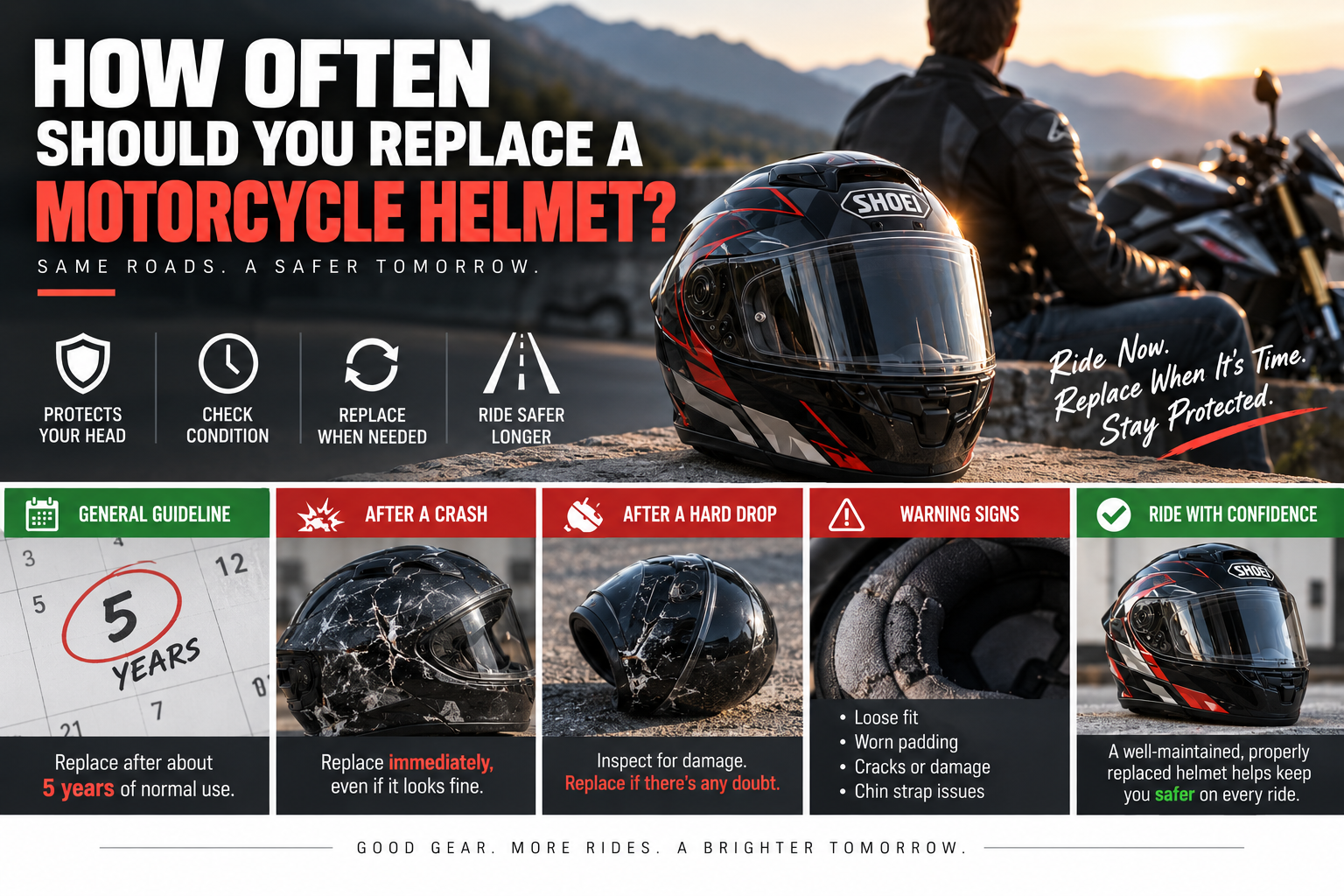
How Often Should You Replace a Motorcycle Helmet?
For most riders, five years of normal use is a practical motorcycle helmet replacement benchmark, but you may need to replace a helmet much sooner after a crash, significant impact, damaged EPS liner, deteriorated retention system, or loss of proper fit. Always follow the replacement instructions provided by your helmet’s manufacturer because recommendations can differ.
The familiar “replace your motorcycle helmet every five years” advice is useful, but it is often oversimplified.
A helmet does not suddenly become useless when the calendar reaches its fifth birthday. At the same time, a helmet that is only two years old should not automatically be considered safe if it has absorbed a crash impact, been seriously damaged, or no longer fits correctly.
In this guide, I’ll explain how often you should replace a motorcycle helmet, why the five-year recommendation exists, when a helmet should be replaced immediately, what happens after a simple drop, and how to recognize the signs that your helmet has reached the end of its useful life.
How Often Should You Replace a Motorcycle Helmet?
A common guideline is to replace a motorcycle helmet after about five years of normal use. However, age should never be your only consideration.
You should consider replacing a helmet sooner if:
- It protected your head during a crash.
- The helmet suffered a significant impact.
- The EPS impact liner is damaged.
- The shell is cracked or seriously damaged.
- The helmet has become noticeably loose.
- The chin strap or retention system is damaged.
- Important structural components have deteriorated.
- The manufacturer recommends an earlier replacement interval.
I therefore treat helmet age as a maximum-use guideline rather than permission to ignore condition.
A three-year-old damaged helmet can need replacement immediately, while an unused helmet stored properly doesn’t necessarily become unusable exactly five years after manufacture.
What Is the 5-Year Motorcycle Helmet Rule?
The so-called five-year helmet rule comes largely from helmet-industry and safety-organization recommendations rather than from the idea that helmet materials magically expire on a precise date.
The Snell Foundation recommends replacing a helmet after approximately five years of normal use.
Its reasoning includes wear to:
- Comfort padding
- Energy-absorbing materials
- Helmet fit
- Retention components
- Other materials affected by repeated use
Every time you put a helmet on, remove it, sweat in it, clean it, carry it, store it, and expose it to environmental conditions, some wear occurs.
That doesn’t mean the helmet becomes dangerous overnight at five years. Rather, five years is a practical point at which accumulated use and deterioration deserve serious consideration.
Motorcycle Helmet Replacement Recommendations by Manufacturer
One reason I don’t like presenting the five-year rule as an absolute law is that helmet manufacturers can publish different replacement guidance.
| Source / Manufacturer | General Guidance | Important Note |
|---|---|---|
| Snell Foundation | About 5 years of normal use | Condition and actual use matter |
| Arai Americas | Within 5 years of first use | Arai also references age, wear and condition |
| SHOEI | Follow current regional/manufacturer guidance | Published guidance differs by market/document |
| Your Helmet Manufacturer | Follow model-specific instructions | This should take priority over a generic internet rule |
Arai, for example, recommends discontinuing use no more than five years after first use. It explains that sweat, skin oils, hair products, cleaners, pollution, UV exposure, liner wear, and other factors contribute to deterioration.
SHOEI also emphasizes that a helmet that has absorbed a substantial impact while being worn should no longer be used.
My rule: Start with the helmet manufacturer’s instructions, then shorten the replacement interval whenever condition, impact history, or fit gives you a reason to do so.
Why Do Motorcycle Helmets Need Replacing?
A motorcycle helmet isn’t a single piece of plastic.
It is a protective system made from several components, typically including:
- Outer shell
- EPS impact-absorbing liner
- Comfort liner
- Cheek pads
- Retention system / chin strap
- Visor
- Ventilation components
- Various adhesives, plastics and hardware
These components don’t necessarily deteriorate at the same rate.
Comfort Padding Compresses
This is one of the changes riders usually notice first.
A new helmet often feels very snug. After months or years of regular riding, cheek pads and comfort materials compress and conform to your head.
Some break-in is normal.
Eventually, however, excessive compression can make the helmet too loose.
Sweat and Skin Oils Accumulate
Your helmet interior regularly encounters:
- Sweat
- Skin oils
- Hair products
- Sunscreen
- Dirt
- Pollution
Regular cleaning helps, but years of repeated use still take their toll.
Environmental Exposure Adds Up
Heat, UV exposure, poor storage conditions, moisture, inappropriate cleaners, and chemicals can affect helmet components.
This is one reason proper helmet maintenance matters throughout the helmet’s entire service life.
Should You Replace a Motorcycle Helmet After a Crash?
Yes. If your helmet protected your head during a significant crash impact, replace it even if the outside still looks normal.
This is one of the most important points in this guide.
Motorcycle helmets manage crash energy partly through an impact-absorbing liner. During a significant impact, that material can compress to help reduce the forces reaching your head.
The problem is that the damage isn’t always visible from outside.
Your helmet can look surprisingly good while hidden impact-absorbing material has already done its job.
One Major Impact Can End a Helmet’s Service Life
SHOEI describes motorcycle helmets as being designed to help absorb one significant impact. If the helmet protects your head during a crash, the manufacturer recommends replacing it.
Snell takes a similar position for helmets involved in an impact while being worn.
I would never decide to continue using a crash-involved helmet simply because:
- The paint still looks good.
- There is no visible crack.
- The visor still works.
- The helmet still feels comfortable.
The condition of the internal energy-management system matters more than cosmetic appearance.
Should You Replace a Motorcycle Helmet After Dropping It?
This question causes enormous confusion.
Dropping an empty motorcycle helmet from a normal height does not automatically mean it must be replaced.
Snell specifically explains that an empty helmet dropped from your hand, motorcycle seat, or handlebar generally doesn’t automatically require replacement.
The situation is very different from crashing while your head is inside the helmet.
Why Is an Empty Drop Different?
During a crash with your head inside the helmet, significant force can be transferred into the impact-absorbing liner.
An empty helmet dropped a relatively short distance doesn’t have the mass of your head loading the liner in the same way.
However, that does not mean you should treat helmets carelessly.
When a Dropped Helmet Needs More Attention
I would stop and investigate if:
- The helmet fell from substantial height.
- It struck something extremely hard.
- A heavy object fell onto it.
- The shell cracked.
- The EPS appears damaged.
- The helmet fell from a moving motorcycle at speed.
- It has been dropped repeatedly.
- You aren’t sure whether the impact compromised it.
In questionable situations, contact the helmet manufacturer or authorized distributor.
If you cannot establish that the helmet remains suitable for use and you suspect meaningful damage, replacing it is the safer decision.
10 Signs You Should Replace Your Motorcycle Helmet
You don’t have to wait for the five-year mark if your helmet is telling you it’s time to retire it.
1. The Helmet Has Been Through a Crash
If your head and helmet took a significant impact, retire the helmet.
2. The Helmet No Longer Fits Snugly
A properly fitted helmet should remain secure on your head.
If it moves excessively when you shake your head, investigate whether replaceable comfort pads can restore the manufacturer’s intended fit or whether the helmet itself should be replaced.
3. The EPS Liner Is Damaged
Dents, cracking, separation, deformation, or other damage to the impact liner should never be ignored.
4. The Shell Is Cracked
A cracked outer shell is an obvious reason to stop using the helmet.
5. The Chin Strap Is Damaged
The retention system helps keep the helmet on your head.
Look for:
- Fraying
- Tearing
- Damaged stitching
- Broken hardware
- Closure problems
6. Internal Components Are Separating
If the EPS liner or other critical internal components are moving, separating, or becoming detached, don’t ignore it.
7. The Helmet Has Suffered Serious Chemical Exposure
Petroleum products, solvents, inappropriate cleaners, and other chemicals may damage helmet materials.
Never assume that a helmet is fine simply because chemical damage isn’t immediately visible.
8. It Has Been Exposed to Extreme Heat
Helmet manufacturers warn against excessive heat because it can affect EPS, plastics, adhesives, and other components.
9. The Helmet Has Seen Years of Heavy Daily Use
A daily commuter’s helmet experiences more wear cycles than a helmet used for ten weekend rides per year.
Usage matters in addition to age.
10. You’ve Reached the Manufacturer’s Recommended Service Life
If you’ve reached the manufacturer’s replacement interval, replacing the helmet is a sensible approach even if it still looks attractive on the outside.
What Happens to the EPS Liner in a Motorcycle Helmet?
The EPS liner is one of the most important safety components inside many motorcycle helmets.
EPS stands for expanded polystyrene.
Its job isn’t primarily to make the helmet comfortable. The soft removable padding handles much of that role.
The EPS is designed to help manage impact energy.
Why You Shouldn’t Press or Modify the EPS
I avoid:
- Digging fingernails into it
- Pressing hard objects into it
- Cutting it
- Sanding it
- Drilling into it
- Using solvents on it
- Storing hard objects inside the helmet
Modifying the impact liner to make a tight helmet fit is particularly bad practice.
If a helmet doesn’t match your head shape, use a properly fitting helmet rather than altering safety-critical materials.
A Loose Helmet Can Be a Replacement Warning
Helmet fit changes over time because the comfort padding breaks in and compresses.
Some compression is expected during the first weeks of ownership.
There is a difference, however, between normal break-in and a helmet becoming genuinely loose after years of use.
Simple Fit Check
Fasten the chin strap and gently move your head left and right.
The helmet should move with your skin rather than freely rotating independently around your head.
If your old helmet now feels dramatically looser than when it was new, inspect the interior.
Some premium helmets allow replacement cheek pads and comfort liners, but these components shouldn’t be used to hide damage to the structural parts of the helmet.
For more information, see our best motorcycle helmet.
Does the Motorcycle Helmet Manufacture Date Matter?
Yes, but manufacture date and time-in-use are not exactly the same thing.
A helmet manufactured several years ago and sitting unused in ideal warehouse conditions has experienced a different life from one worn for thousands of miles in heat, sweat, rain, and sunlight.
This is why you should distinguish between:
- Manufacture date
- Purchase date
- Date of first use
- Actual amount of riding
- Storage history
Where Can You Find the Manufacture Date?
The exact location varies by brand and model.
It may appear:
- On a label inside the helmet
- On the chin strap
- Near the D-rings
- Under the comfort liner
- On a manufacturer information sticker
Arai, for example, has used date information on its chin strap/D-ring area on various helmets.
Do Unused Motorcycle Helmets Expire?
This deserves a more nuanced answer than a simple yes or no.
An unused motorcycle helmet stored properly does not necessarily become unsafe exactly five years after it was manufactured.
Snell specifically notes that unused helmets stored in good condition do not automatically expire after five years.
Its five-year recommendation focuses on normal use and accumulated wear.
However, that doesn’t mean I would buy an extremely old new-old-stock helmet without thinking carefully.
Before Buying an Older New Helmet, Check:
- Manufacture date
- Storage history
- Current safety certification
- Availability of replacement visors
- Availability of cheek pads and liners
- Availability of spare parts
- Manufacturer support
- Warranty coverage
Sometimes a heavily discounted old helmet isn’t such a bargain if the model has been discontinued and replacement parts are becoming difficult to obtain.
Can Proper Storage Make a Motorcycle Helmet Last Longer?
Proper storage helps prevent unnecessary deterioration, but it doesn’t make a helmet immortal.
Store your helmet somewhere:
- Cool
- Dry
- Well ventilated
- Away from direct sunlight
- Away from excessive heat
- Away from gasoline and solvents
- Protected from accidental impacts
After a sweaty or rainy ride, allow the helmet to dry before sealing it inside a storage bag.
For a complete storage routine, see how to store a motorcycle helmet properly.
Does a Daily Rider Need to Replace a Helmet Sooner?
Potentially, yes.
Think about two helmets that are both four years old.
Helmet A: used five days per week for commuting in hot weather.
Helmet B: used on occasional weekend rides and stored indoors between rides.
The number on the calendar is identical, but their usage histories are completely different.
The daily helmet experiences more:
- Sweat
- UV exposure
- Heat
- Putting-on/removal cycles
- Interior compression
- Cleaning cycles
- Visor wear
- General handling
That is why I inspect high-mileage helmets more frequently rather than relying exclusively on age.
Does Helmet Type Change Replacement Frequency?
The same basic replacement principles apply to:
- Full-face helmets
- Modular helmets
- Open-face helmets
- Adventure helmets
- Motocross helmets
- Half helmets
However, the number of moving parts and replaceable components can differ.
A modular helmet, for example, includes a chin-bar mechanism that should also be inspected according to manufacturer instructions.
An off-road helmet may encounter more dirt, sweat, mud, cleaning, and physical abuse than a lightly used touring helmet.
The best interval is therefore always a combination of manufacturer guidance + age + usage + condition + impact history.
Motorcycle Helmet Inspection Checklist
I recommend making helmet inspection part of your normal riding routine rather than waiting until the helmet is five years old.
Check Your Helmet for:
- ✓ Shell cracks or significant damage
- ✓ EPS liner dents or deterioration
- ✓ Loose internal components
- ✓ Excessively compressed padding
- ✓ Loose overall fit
- ✓ Frayed chin strap
- ✓ Damaged D-rings or buckle
- ✓ Broken visor mechanism
- ✓ Visor cracks or serious scratches
- ✓ Broken vents or trim
- ✓ Signs of chemical damage
- ✓ Signs of heat damage
- ✓ Unusual noises or movement inside the helmet
If you discover structural damage or you’re uncertain whether an impact has compromised the helmet, stop treating it as normal riding gear until you’ve consulted the manufacturer or determined that replacement is necessary.
Motorcycle Helmet Replacement Decision Table
| Helmet Condition | Replace? | Recommended Action |
|---|---|---|
| 5 years of regular use | Generally Yes | Follow manufacturer replacement guidance |
| Major crash with helmet impact | Yes | Replace immediately |
| Minor empty drop from seat | Not automatically | Inspect and follow manufacturer guidance |
| Cracked shell | Yes | Stop using |
| Damaged EPS liner | Yes / professional evaluation | Do not ignore structural damage |
| Helmet significantly too loose | Possibly | Inspect padding and overall helmet condition |
| Damaged chin strap | Yes or approved repair | Follow manufacturer instructions |
| Unused 5-year-old helmet | Not automatically | Evaluate storage, age, manufacturer guidance and condition |
| Repeated hard drops | Possibly | Seek manufacturer evaluation or replace |
| Serious solvent/chemical exposure | Possibly / Likely | Consult manufacturer before further use |
Can You Replace the Liner Instead of the Whole Helmet?
Sometimes—but only when the worn component is a replaceable comfort component rather than the structural impact liner.
Many helmets offer replaceable:
- Cheek pads
- Crown pads
- Chin curtains
- Visors
- Breath guards
Replacing worn cheek pads can restore comfort and fit when the helmet’s structural components remain in good condition and the helmet is still within its intended service life.
But replacing comfort padding doesn’t undo:
- Crash damage
- Compacted impact liner
- Cracked shell
- Structural deterioration
- Major chemical damage
Don’t confuse a fresh interior with a structurally new helmet.
Should You Buy a Used Motorcycle Helmet?
I generally prefer buying a new helmet from a reputable seller because helmet history matters enormously.
With a used helmet, you may not know:
- Whether it was crashed
- Whether it was dropped repeatedly
- How it was stored
- Whether it was exposed to excessive heat
- Whether solvents were used on it
- How heavily it was worn
- Whether internal components were modified
A motorcycle helmet can hide damage that isn’t obvious in marketplace photos.
Since head protection is the purpose of the product, saving money isn’t worth much if you can’t establish the helmet’s history.
Should You Replace a Helmet Just Because a New Safety Standard Appears?
Not automatically.
A helmet meeting the legally required and appropriate certification for your market does not instantly become unusable because a newer certification standard enters the market.
However, new helmet generations can introduce:
- Updated certification
- Improved ventilation
- Reduced weight
- New visor systems
- Better aerodynamics
- Updated impact-management designs
- Improved comfort
If your existing helmet is already approaching replacement age, the availability of newer standards and newer designs can be another good reason to upgrade.
My Helmet Replacement Rule
I use four questions:
- Has it absorbed a significant crash impact?
If yes, replace it. - Is there structural damage or questionable deterioration?
If yes, stop using it until the manufacturer evaluates it or replace it. - Does it still fit securely?
If no, determine whether approved replacement padding can correctly restore fit; otherwise replace it. - Has it reached the manufacturer’s recommended service life?
If yes, plan to replace it even if it still looks attractive.
This approach makes more sense to me than looking only at a manufacture-date sticker.
Quick Answer: When Should You Replace Your Helmet?
- After approximately 5 years of normal use: commonly recommended.
- After a significant crash impact: replace immediately.
- After a small empty drop: replacement is not automatically required.
- If the shell or EPS is damaged: stop using it.
- If the helmet becomes excessively loose: inspect and replace if proper fit cannot be restored.
- If the chin strap is damaged: repair only through an approved method or replace the helmet.
- If exposed to damaging chemicals or extreme heat: consult the manufacturer.
- If manufacturer guidance says replace sooner: follow the manufacturer.
Frequently Asked Questions
How often should you replace a motorcycle helmet?
A common recommendation is approximately every five years of normal use, but the exact interval depends on the manufacturer, helmet condition, usage, storage and impact history. Replace a helmet sooner if it has absorbed a significant crash impact or has structural damage.
Do motorcycle helmets really expire after five years?
Not in the sense that a helmet automatically stops working on a specific fifth-anniversary date. Five years is a widely used service-life guideline reflecting accumulated wear and use. Follow the recommendation from your specific helmet manufacturer.
How long do motorcycle helmets last?
Many riders use five years as a general maximum interval for regularly used helmets, but lifespan can be shorter because of crashes, heavy use, deterioration, poor storage, chemicals, heat, damage or loss of proper fit.
Do you have to replace a motorcycle helmet after a crash?
If your helmet absorbed a significant impact while protecting your head during a crash, it should be replaced. Internal impact-absorbing material can be compressed even when the shell appears relatively undamaged.
Do I need to replace my helmet if I drop it?
Not necessarily. A normal empty drop from a short height does not automatically require helmet replacement. However, investigate substantial impacts, repeated drops, high-speed falls, visible damage or any situation where you aren’t confident about the helmet’s condition.
Can you tell if a motorcycle helmet is damaged by looking at it?
Not always. Some impact damage can occur beneath the outer shell, which is one reason a helmet that absorbed a significant crash impact should not be considered safe merely because it still looks good externally.
Does an unused motorcycle helmet expire?
An unused helmet stored correctly does not necessarily expire exactly five years after manufacture. Snell notes that unused helmets stored in good condition do not automatically expire after five years. Manufacturer age limits, storage history, certification, parts availability and helmet condition should still be considered.
Should I replace a helmet if it feels loose?
A helmet that has become significantly loose deserves attention because correct fit is critical. Replaceable cheek pads or comfort liners may restore proper fit in some helmets, but an old or deteriorated helmet should not be kept in service merely by installing fresh padding.
Can motorcycle helmet padding be replaced?
Many manufacturers offer replaceable comfort liners and cheek pads. These can refresh comfort and fit but are different from the structural EPS impact liner and cannot repair crash damage.
Where is the manufacture date on a motorcycle helmet?
The location varies by manufacturer. Look inside the helmet, on labels beneath the comfort liner, around the chin strap or D-rings, or consult the owner’s manual for your specific helmet.
Is a 10-year-old motorcycle helmet safe?
I would generally replace a 10-year-old regularly used motorcycle helmet. It is well beyond the five-year normal-use benchmark recommended by organizations such as Snell and manufacturers such as Arai. An unused old-stock helmet requires a more nuanced evaluation, but its age, storage history, parts availability and manufacturer guidance should still be considered.
Does replacing cheek pads extend helmet life?
Fresh cheek pads can restore fit and comfort when the rest of the helmet remains suitable for use, but they don’t reset the helmet’s age or repair structural damage to the shell or impact-absorbing liner.
Final Thoughts
So, how often should you replace a motorcycle helmet?
For a regularly used helmet, around five years is a sensible general benchmark, but it is not the only rule that matters.
Replace your helmet sooner if it has protected you during a significant crash, suffered structural damage, developed a compromised impact liner, lost its proper fit, or reached a shorter service interval specified by its manufacturer.
At the same time, don’t automatically throw away an otherwise sound helmet simply because you accidentally dropped it empty from your motorcycle seat. A minor empty drop and a helmet-loaded crash impact are not equivalent events.
I think the most useful way to evaluate motorcycle helmet lifespan is to consider age, actual use, condition, fit, storage, impact history and manufacturer recommendations together.
Your helmet exists to manage an event you hope never happens. When there is meaningful doubt about whether it can still perform that job, replacing it is a much better gamble than trying to squeeze another season from questionable protective equipment.
Authoritative Sources
- Snell Foundation – Helmet Certification FAQ and Helmet Replacement Guidance
- Arai Americas – Warranty, Helmet Lifespan and Consumer Information
- SHOEI – Helmet Safety Instructions, Maintenance and Replacement Guidance
- National Highway Traffic Safety Administration – Motorcycle Helmet Fit and Safety Information

Daniel Carter | Motorcycle Gear Specialist & Helmet Expert
Daniel Carter is a rider and motorcycle equipment analyst specializing in helmet safety standards, protective apparel, and riding technology. He provides in-depth technical reviews and gear advice to help riders stay safe, comfortable, and fully equipped on every journey.
Editor & Author @ BestMotorcycleHelmet.com