Motorcycle Riding Gear: Complete Guide to Essential Protective Gear
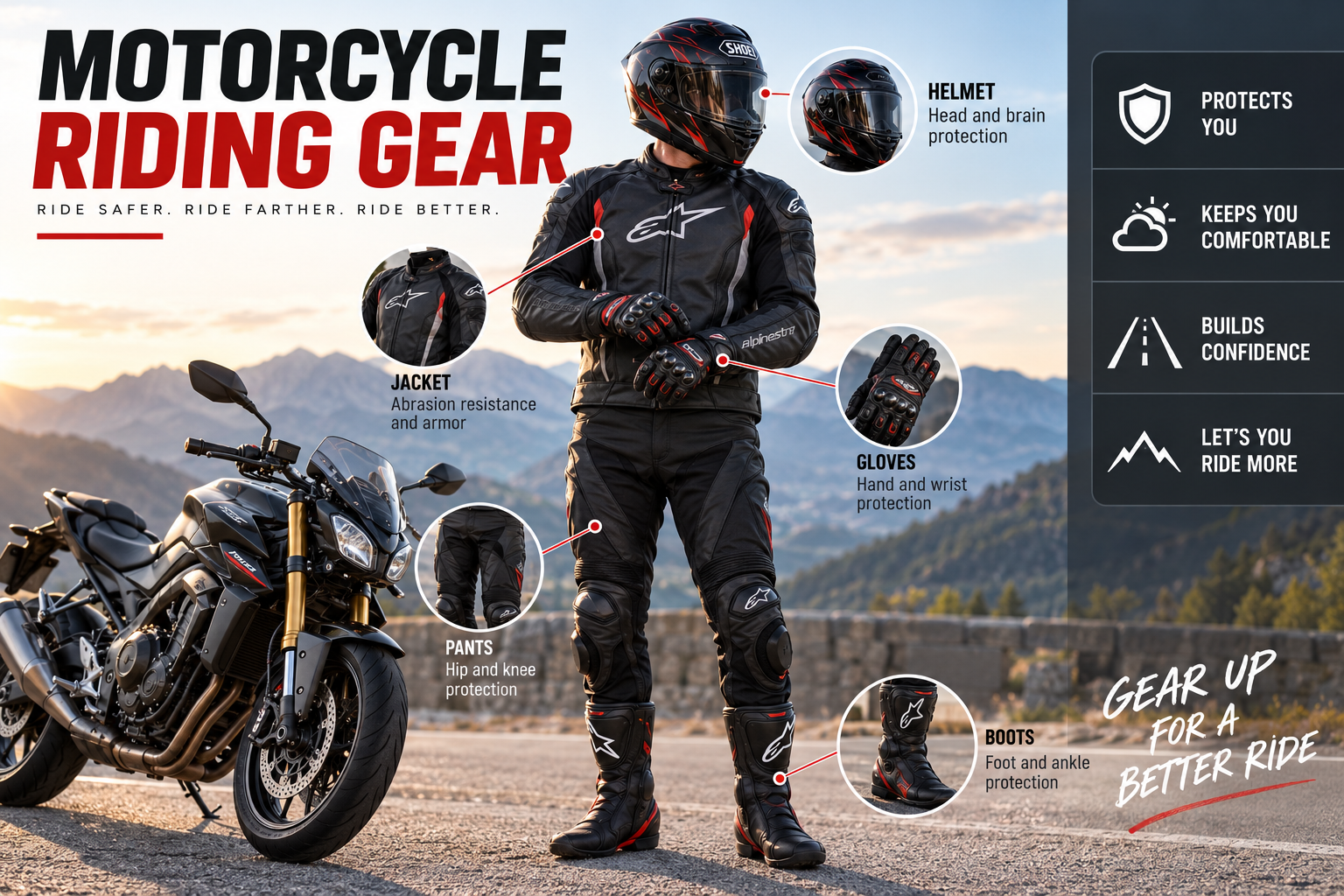
A complete motorcycle riding gear setup should include a properly fitted motorcycle helmet, abrasion-resistant jacket, protective riding pants, full-finger motorcycle gloves, over-the-ankle boots, and appropriate eye protection. For stronger protection, look for purpose-built motorcycle clothing with impact protectors at vulnerable areas such as the shoulders, elbows, back, hips, and knees.
I’ve found that choosing motorcycle gear becomes much easier once you stop thinking about individual products and start thinking about head-to-toe protection. Every piece has a different job: the helmet protects your head, armor manages impacts, abrasion-resistant materials protect your skin, gloves protect your hands, and boots protect your feet and ankles.
This complete guide explains the different types of motorcycle riding gear, what each item does, what specifications I look for, and where I think beginners should spend their money first.
What Is Motorcycle Riding Gear?
Motorcycle riding gear is purpose-built protective equipment designed to reduce injuries and improve rider comfort, control, visibility, and weather protection.
Unlike ordinary street clothing, quality motorcycle gear can combine abrasion-resistant materials with strategically positioned impact protection.
A complete riding setup typically consists of:
- Motorcycle helmet
- Protective jacket
- Motorcycle pants
- Motorcycle gloves
- Motorcycle boots
- Eye protection
- Optional back and chest protection
- Weather-specific layers
I consider all of these components part of a system. Buying an excellent helmet while riding in shorts, sneakers, and bare hands still leaves large parts of your body unnecessarily exposed.
Essential Motorcycle Riding Gear Checklist
| Gear | Main Purpose | Priority | What I Look For |
|---|---|---|---|
| Helmet | Head and brain protection | Essential | Proper certification and correct fit |
| Jacket | Abrasion and upper-body protection | Essential | Abrasion resistance + armor |
| Pants | Hip, knee and leg protection | Essential | Motorcycle-specific construction |
| Gloves | Hand and wrist protection | Essential | Full fingers, secure closure, reinforced palm |
| Boots | Foot and ankle protection | Essential | Over-ankle coverage and secure fit |
| Eye Protection | Protects eyes from debris and wind | Essential | Clear vision and impact resistance |
| Back Protector | Additional back impact protection | Recommended | Proper coverage and fit |
| Chest Protector | Additional torso protection | Optional/Recommended | Impact-rated design |
| Earplugs | Reduces wind-noise exposure | Recommended | Comfortable attenuation |
| Rain Gear | Weather protection | Situational | Waterproofing and visibility |
1. Motorcycle Helmet
If I could choose only one piece of protective motorcycle equipment, it would obviously be the helmet. Your head and brain simply aren’t areas where compromising protection makes sense.
For riders in the United States, look for a helmet that complies with DOT FMVSS No. 218. Depending on the market and helmet, you may also encounter certifications or testing standards such as ECE and Snell.
The certification sticker isn’t the only consideration, however. Fit matters enormously.
Motorcycle Helmet Types
| Helmet Type | Coverage | Best For |
|---|---|---|
| Full-Face | Maximum head and face coverage | Street, sport, highway riding |
| Modular | Full coverage with lifting chin bar | Touring and commuting |
| Adventure / Dual-Sport | Full coverage with ADV features | Adventure riding |
| Off-Road | Extended chin bar and peak | Motocross and trails |
| Open-Face | Head coverage without chin bar | Urban and cruiser riding |
| Half Helmet | Limited coverage | Primarily cruiser applications |
Why I Prefer Full-Face Helmets
For most street riding, I prefer a full-face motorcycle helmet. It provides coverage around the head, face, and chin while also giving you a visor for protection against wind, insects, rain, and road debris.
A helmet should feel evenly snug without painful pressure points. It shouldn’t rotate freely around your head when you move it.
Before buying, measure your head and compare the measurement with the specific manufacturer’s sizing chart rather than assuming you always wear the same helmet size.
For more detail, see our bestmotorcyclehelmet.com.
2. Motorcycle Jacket
A motorcycle jacket isn’t simply a heavier version of a casual jacket.
Purpose-built motorcycle jackets are designed around riding posture, abrasion resistance, weather protection, and impact protection.
Leather vs Textile Motorcycle Jackets
| Feature | Leather | Textile |
|---|---|---|
| Abrasion Resistance | Typically excellent with quality construction | Varies by material and certification |
| Ventilation | Moderate unless perforated | Can be excellent |
| Rain Performance | Usually requires additional treatment/layer | Many waterproof options |
| Weight | Usually heavier | Usually lighter |
| Touring | Good | Excellent |
| Sport Riding | Excellent | Good to excellent |
| Hot Weather | Perforated leather works well | Mesh options are excellent |
Motorcycle Jacket Armor
I look for armor at the:
- Shoulders
- Elbows
- Back
Some jackets include a proper back protector, while others include only a basic foam insert or an empty pocket. Check the specifications instead of assuming that “armored jacket” means every protective component is included.
3. Motorcycle Riding Pants
Regular jeans may feel substantial, but they’re not automatically designed for motorcycle crashes.
Motorcycle-specific riding pants can incorporate abrasion-resistant fabrics, reinforced impact zones, and armor around the knees and hips.
Common Motorcycle Pants
- Leather pants: Excellent for performance-oriented riding.
- Textile pants: Versatile for commuting, touring, and adventure riding.
- Mesh pants: Useful for hot-weather riding.
- Motorcycle jeans: Casual appearance with motorcycle-specific protective construction.
- Overpants: Designed to fit over normal clothing for commuting.
If I’m choosing motorcycle jeans, I look beyond appearance. I want to know exactly what abrasion-resistant materials are used, whether the garment has been tested or certified, and whether knee and hip protectors are included.
4. Motorcycle Gloves
Your hands instinctively tend to reach toward the ground during a fall, making gloves one of the pieces of gear I never ride without.
A good motorcycle glove should protect without interfering with throttle, brake, clutch, and switch operation.
What I Look for in Motorcycle Gloves
- Full-finger coverage
- Secure wrist closure
- Reinforced palm
- Impact protection around the knuckles
- Abrasion-resistant construction
- Good control feel
- Correct finger length
The glove should stay securely attached if your hand slides across the road. A glove that simply slips off defeats much of its purpose.
Short vs Gauntlet Gloves
Short-cuff gloves are convenient for commuting and hot weather.
Gauntlet gloves extend farther over the wrist and work especially well for sport, touring, cold-weather, and higher-speed riding.
5. Motorcycle Boots
Motorcycle footwear should do more than protect the bottom of your feet.
I look for boots that cover the ankle and provide support and protection around vulnerable areas.
Important Motorcycle Boot Features
- Over-the-ankle construction
- Secure fastening system
- Reinforced toe area
- Heel protection
- Ankle protection
- Oil-resistant or high-grip sole
- Shift-pad reinforcement where appropriate
Loose laces are another concern because they can potentially become caught around motorcycle controls or moving components.
Types of Motorcycle Boots
| Boot Type | Best Use | Typical Protection |
|---|---|---|
| Racing Boots | Track / Sport | Very High |
| Touring Boots | Long-distance riding | High |
| Adventure Boots | ADV / Dual-Sport | High |
| Motocross Boots | Off-road | Very High |
| Urban Riding Boots | Commuting | Moderate to High |
| Motorcycle Shoes | Urban riding | Varies considerably |
6. Motorcycle Body Armor
Abrasion resistance and impact protection aren’t the same thing.
The outer garment helps resist sliding and tearing, while armor is intended to help manage impact forces at vulnerable parts of the body.
Common Armor Locations
- Shoulders
- Elbows
- Back
- Chest
- Hips
- Knees
When shopping for European-certified motorcycle clothing, you may see references to standards including EN 17092 for protective motorcycle garments and EN 1621 for various motorcycle impact protectors.
CE Level 1 vs Level 2 Armor
You will commonly encounter Level 1 and Level 2 impact protectors.
Level 2 protectors are tested to allow lower transmitted forces than Level 1 protectors under the applicable standard, although they may sometimes be thicker, heavier, or less flexible depending on their design.
Modern viscoelastic protectors can be surprisingly thin and comfortable, so I don’t automatically assume better protection must mean bulky armor.
7. Motorcycle Eye and Face Protection
At motorcycle speeds, something as small as an insect can become a serious distraction when it hits your eye.
Eye protection helps shield you from:
- Wind
- Dust
- Insects
- Small stones
- Rain
- Road debris
Full-face helmets normally provide this through their face shields.
Open-face helmet users may need appropriate motorcycle goggles or other suitable eye protection.
I also avoid using heavily tinted visors at night because reduced light transmission makes already limited nighttime visibility worse.
8. Motorcycle Hearing Protection
Hearing protection is often overlooked because riders associate motorcycle noise primarily with the exhaust.
At highway speeds, however, wind noise around the helmet can become substantial.
Properly fitted motorcycle earplugs can reduce noise exposure without eliminating your awareness of surrounding traffic.
Common options include:
- Disposable foam earplugs
- Reusable filtered earplugs
- Custom-molded earplugs
I prioritize comfort because hearing protection isn’t useful if it becomes painful after 30 minutes and you stop wearing it.
9. Motorcycle Base Layers
Base layers aren’t crash protection, but they can make protective riding gear considerably more comfortable.
In hot weather, moisture-wicking layers help manage sweat. In cold weather, thermal base layers help retain warmth without requiring excessively bulky outer clothing.
Avoid Cotton for Extreme Conditions
Cotton absorbs moisture and can remain wet for a long time.
For demanding riding conditions, I generally prefer synthetic technical fabrics or merino wool depending on temperature and personal preference.
10. Motorcycle Rain Gear
If you tour or commute regularly, rain protection can quickly become essential equipment.
You have two basic approaches:
- Wear waterproof motorcycle gear.
- Carry a waterproof outer rain suit.
Waterproof membranes built into jackets and pants are convenient, while lightweight over-suits can be inexpensive and pack down small.
For heavy rain, I also pay attention to:
- Waterproof gloves
- Waterproof boots
- Neck sealing
- Visor anti-fog performance
- Reflective detailing
Best Motorcycle Riding Gear for Summer
Hot weather creates a genuine gear dilemma: you want protection without overheating.
My solution isn’t to eliminate gear. It’s to choose equipment designed for airflow.
Summer Setup
- Ventilated full-face helmet
- Mesh or highly ventilated motorcycle jacket
- Ventilated motorcycle pants
- Perforated gloves
- Ventilated riding boots
- Moisture-wicking base layer
Hydration is also important. Protective clothing doesn’t eliminate the need to drink enough water and manage heat exposure.
Best Motorcycle Riding Gear for Winter
Cold weather requires a different strategy.
Instead of wearing one extremely bulky garment, I prefer layering.
Winter Layering System
- Base layer: manages moisture and provides initial insulation.
- Insulating layer: traps warm air.
- Protective outer layer: provides abrasion, impact, wind, and weather protection.
Cold hands are especially problematic because they can interfere with fine control inputs.
Winter gloves, heated grips, hand guards, or heated motorcycle gear can improve comfort during genuinely cold rides.
Motorcycle Riding Gear by Riding Style
The best gear setup depends partly on how and where you ride.
| Riding Style | Recommended Gear Characteristics |
|---|---|
| Daily Commuting | Comfortable, easy to wear, weather-resistant, visible |
| Sport Riding | High abrasion resistance and extensive impact protection |
| Touring | Weatherproof, comfortable, ventilated, adaptable |
| Adventure | Ventilated, weather adaptable, robust protection |
| Off-Road | Maximum ventilation plus dedicated impact protection |
| Cruiser | Protective street gear with comfort for upright riding |
| Track | Full-face helmet, leather suit, gauntlet gloves, racing boots |
Motorcycle Riding Gear for Beginners
If you’re a new rider working with a limited budget, I would rather see you buy a complete set of reasonably priced protective equipment than spend nearly everything on one premium item and leave the rest of your body unprotected.
My Beginner Gear Priority
- Properly fitted certified helmet
- Motorcycle jacket with armor
- Full-finger motorcycle gloves
- Over-the-ankle motorcycle boots
- Protective motorcycle pants
Ideally, buy all five before you begin regular road riding.
Where Should You Spend More?
I prioritize fit, protection, and certification over branding.
An expensive jacket that doesn’t fit correctly may allow the armor to move away from your elbow or shoulder when you need it. Likewise, an expensive helmet isn’t automatically better for you if its internal shape doesn’t match your head.
How Should Motorcycle Riding Gear Fit?
Protective motorcycle equipment generally needs to fit more securely than casual clothing.
The objective is to prevent protective components from moving significantly away from the body areas they’re intended to protect.
Helmet Fit
The helmet should create firm, even pressure around your head without painful hot spots. When you move the helmet, your scalp should move with it rather than the helmet freely rotating around your head.
Jacket Fit
Shoulder and elbow protectors should remain positioned over the corresponding joints while you’re sitting in your normal riding posture.
Pants Fit
Knee armor should cover your knees when you’re seated on the motorcycle—not merely when you’re standing upright.
Glove Fit
Your fingertips shouldn’t be excessively compressed, but too much empty space can interfere with control feel.
Boot Fit
Your heel should remain secure, and you should still be able to operate the shifter and rear brake comfortably.
Understanding Motorcycle Gear Safety Standards
Standards can seem confusing when you’re shopping for riding gear, but they’re useful because they give you more information than marketing terms such as “heavy duty” or “race inspired.”
Helmet Standards
Depending on your country, common helmet standards include:
- DOT FMVSS 218
- ECE 22.06
- Snell standards
Use a helmet legally certified for the market where you ride.
Motorcycle Clothing Classification
European motorcycle protective garments may be classified under EN 17092.
You may encounter:
- AAA – highest protection class within the standard’s garment classifications.
- AA – strong balance between protection and ergonomics.
- A – lower protective performance with potentially greater comfort and mobility.
- B – abrasion protection without integrated impact protectors.
Don’t judge a jacket solely by how thick or heavy it feels. Look at the actual certification label and included armor.
How to Choose Motorcycle Riding Gear
When I evaluate riding gear, I use the following factors rather than focusing primarily on styling.
1. Protection
Start with the actual protective function.
Check:
- Safety certification
- Abrasion-resistant materials
- Impact armor
- Armor coverage
- Seam construction
- Retention systems
2. Fit
Excellent protective equipment becomes less useful if it doesn’t stay where it belongs.
Whenever possible, try the gear while sitting in a motorcycle-like riding position.
3. Climate
A rider in a tropical climate needs a very different setup from someone riding through freezing winters.
Consider:
- Average temperature
- Humidity
- Rain frequency
- Ride duration
- Typical speed
4. Ventilation
Look for intelligently placed vents, perforated panels, or mesh areas appropriate for your riding conditions.
Ventilation is especially important in helmets, jackets, pants, gloves, and boots used in hot climates.
5. Weather Protection
Touring and commuting gear often benefits from waterproof construction.
Check whether the waterproof membrane is:
- Fixed
- Removable
- Laminated to the outer shell
6. Visibility
Black remains extremely popular in motorcycle equipment, but brighter colors and reflective materials can improve conspicuity.
I particularly value reflective elements when riding at night or in poor weather.
7. Comfort
Comfort is a safety consideration too.
Gear that causes severe pressure points, overheating, restricted movement, or distraction can make long rides miserable.
8. Build Quality
I inspect areas that receive heavy use:
- Zippers
- Seams
- Velcro
- Snaps
- Glove palms
- Boot soles
- Armor pockets
- Helmet visor mechanisms
How Much Should Motorcycle Riding Gear Cost?
You don’t need the most expensive equipment available, but I wouldn’t choose safety gear based solely on the lowest price.
| Gear | Typical Budget Strategy |
|---|---|
| Helmet | Prioritize certification, fit, comfort and construction |
| Jacket | Prioritize abrasion resistance and armor |
| Pants | Prioritize abrasion resistance plus hip/knee protection |
| Gloves | Prioritize palm protection and secure retention |
| Boots | Prioritize ankle, heel and foot protection |
The sweet spot is often mid-range gear from established motorcycle equipment manufacturers. Premium equipment can provide better materials, lighter armor, ventilation, weather protection, finishing, or comfort, but price alone isn’t a safety rating.
10 Motorcycle Riding Gear Mistakes I Would Avoid
- Buying a helmet that’s too large.A loose helmet can move excessively and won’t fit as intended.
- Riding without gloves.Your hands are highly vulnerable during a fall.
- Assuming normal jeans provide motorcycle-level protection.Use motorcycle-specific pants designed for abrasion and impact protection.
- Wearing low-cut casual shoes.They leave your ankles exposed and may offer little structural protection.
- Buying gear solely by appearance.Certification, materials, armor, construction and fit matter more.
- Removing armor because it feels uncomfortable.Try better-fitting or more flexible armor instead.
- Using dark tinted visors at night.Reduced light transmission can seriously compromise vision.
- Buying gear that doesn’t match your climate.Extremely hot or cold equipment can become a distraction.
- Ignoring visibility.Reflective or brighter elements can help other road users notice you.
- Forgetting maintenance.Inspect protective equipment regularly for damage and excessive wear.
How to Care for Motorcycle Riding Gear
Good gear deserves proper maintenance.
Helmet
- Keep it clean and dry.
- Use manufacturer-approved cleaning methods.
- Avoid petroleum solvents.
- Keep it away from excessive heat.
- Store it securely.
See our complete guide on how to store a motorcycle helmet.
Jackets and Pants
Follow the manufacturer’s washing instructions, especially when waterproof membranes, leather, or removable armor are involved.
Leather Gear
Use appropriate leather-care products and allow wet leather to dry naturally rather than placing it directly against intense heat.
Gloves
Let gloves dry after wet or sweaty rides and inspect the palms, stitching, closures, and protective panels periodically.
Boots
Keep the soles clean, allow the boots to dry properly, and inspect closures and structural components regularly.
Motorcycle Riding Gear: My Ideal Head-to-Toe Setup
For everyday street riding, my preferred setup is:
- ✓ Properly fitted full-face certified helmet
- ✓ Abrasion-resistant motorcycle jacket
- ✓ Shoulder and elbow armor
- ✓ Proper back protector
- ✓ Protective motorcycle pants
- ✓ Hip and knee armor
- ✓ Full-finger motorcycle gloves
- ✓ Over-the-ankle motorcycle boots
- ✓ Clear eye protection
- ✓ Hearing protection for sustained higher-speed riding
I then modify ventilation, insulation, and waterproofing according to the weather rather than eliminating the core protective equipment.
Quick Motorcycle Riding Gear Checklist Before Every Ride
- ✓ Helmet fits correctly and chin strap is secured.
- ✓ Visor is clean and provides appropriate visibility.
- ✓ Jacket is fully secured.
- ✓ Armor is correctly positioned.
- ✓ Pants provide full leg protection.
- ✓ Gloves are securely fastened.
- ✓ Boots cover and protect the ankles.
- ✓ Loose straps and laces are secured.
- ✓ Gear is appropriate for current weather.
- ✓ Reflective or visible elements are available for low-light riding.
Frequently Asked Questions About Motorcycle Riding Gear
What motorcycle riding gear do I really need?
At minimum, I recommend a properly fitted certified motorcycle helmet, abrasion-resistant motorcycle jacket, protective pants, full-finger gloves, over-the-ankle motorcycle boots, and appropriate eye protection.
What is the most important motorcycle safety gear?
The helmet is the most important single piece of motorcycle protective equipment because it protects your head and brain. However, a helmet doesn’t protect your hands, legs, feet, hips, shoulders, or torso, which is why a complete set of riding gear is preferable.
Should beginners buy motorcycle gear before buying a motorcycle?
Ideally, budget for your protective equipment at the same time you budget for the motorcycle. Don’t spend your entire budget on the bike and leave nothing available for properly fitted riding gear.
Are jeans good enough for motorcycle riding?
Ordinary fashion jeans aren’t designed specifically for motorcycle crash protection. Motorcycle jeans may incorporate abrasion-resistant materials, reinforced construction, and knee and hip armor while maintaining a casual appearance.
Do I need motorcycle boots?
I recommend motorcycle-specific over-the-ankle footwear. Motorcycle boots can provide additional ankle, heel, foot, abrasion, and impact protection compared with ordinary low-cut shoes.
Do I need motorcycle gloves?
Yes. Full-finger motorcycle gloves protect your hands from weather and debris and can provide abrasion and impact protection during a crash. They should also fit well enough to maintain precise control of the motorcycle.
Is leather or textile motorcycle gear better?
Neither is automatically best for every rider. Quality leather is popular for its abrasion resistance, particularly in sport and track applications, while textile gear can offer excellent versatility, ventilation, waterproofing, and comfort for commuting, touring, and adventure riding.
Is expensive motorcycle gear safer?
Not necessarily. Price can reflect materials, comfort, ventilation, waterproofing, brand, finishing, and features. Look at safety certification, armor, abrasion resistance, construction, coverage, and fit rather than assuming the most expensive product is automatically the safest.
Should motorcycle riding gear fit tightly?
Protective gear should fit securely enough to keep armor correctly positioned without restricting normal motorcycle controls or circulation. Helmet fit should be snug and even, while jacket and pants armor should remain over the intended joints in your riding position.
What should I wear when riding a motorcycle in summer?
Choose ventilated motorcycle equipment rather than riding without protection. A ventilated helmet, mesh or highly ventilated jacket and pants, perforated gloves, breathable boots, and moisture-wicking base layer can significantly improve hot-weather comfort.
Final Thoughts: Build Your Motorcycle Gear as a Complete System
The best approach to motorcycle riding gear is to think from head to toe rather than focusing on a single product.
Your helmet protects your head. Your jacket and pants provide abrasion resistance and hold armor over vulnerable areas. Your gloves protect your hands, while motorcycle boots protect your feet and ankles. Eye and hearing protection address additional hazards that become increasingly noticeable as your riding speed and distance increase.
If you’re just starting out, don’t worry about owning the most expensive equipment available. Focus first on proper fit, legitimate safety standards, adequate coverage, abrasion resistance, impact protection, and gear that suits your riding environment.
Most importantly, choose gear comfortable enough that you’ll actually wear it consistently.
Authoritative Sources & Further Reading
Daniel Carter | Motorcycle Gear Specialist & Helmet Expert
Daniel Carter is a rider and motorcycle equipment analyst specializing in helmet safety standards, protective apparel, and riding technology. He provides in-depth technical reviews and gear advice to help riders stay safe, comfortable, and fully equipped on every journey.
Editor & Author @ BestMotorcycleHelmet.com